
Elastomer characteristics
Elastomers are the result of complex formulations comprising rubber, fillers, plasticisers, cross-linking chemicals and anti-ageing agents.
Each combination results in a compound with a specific property profile. To ensure that this profile is reproducible and reliable for the respective application, the characteristic properties of the elastomer must be systematically tested and documented.
For O-rings, seals, profiles and moulded parts, comprehensive compound control is essential to ensure that failures, dimensional deviations and functional defects during use are kept to a minimum. Testing takes place at three stages: raw materials, uncured rubber compounds and fully cured components.
Standards and test principles
Comparable test results require standardised test methods and standardised test specimen geometries. In Germany, the DIN standards are authoritative in this regard, supplemented by international ISO standards. For international projects and supply chains – particularly with North American partners – the ASTM standards are used, which differ in part from their DIN counterparts in terms of methodology and test specimen geometry. Results from different standardisation systems are therefore only directly comparable to a limited extent – a factor that must be taken into account when interpreting material data sheets from different sources.
Unless expressly stated otherwise, tests are carried out at room temperature. For properties that are temperature-dependent – such as compression set or ageing resistance – additional tests are carried out at elevated temperatures to simulate long-term behaviour under operating conditions.
Mechanical characteristics
The mechanical properties of an elastomer describe its behaviour when subjected to force and deformation. The most important parameters include:
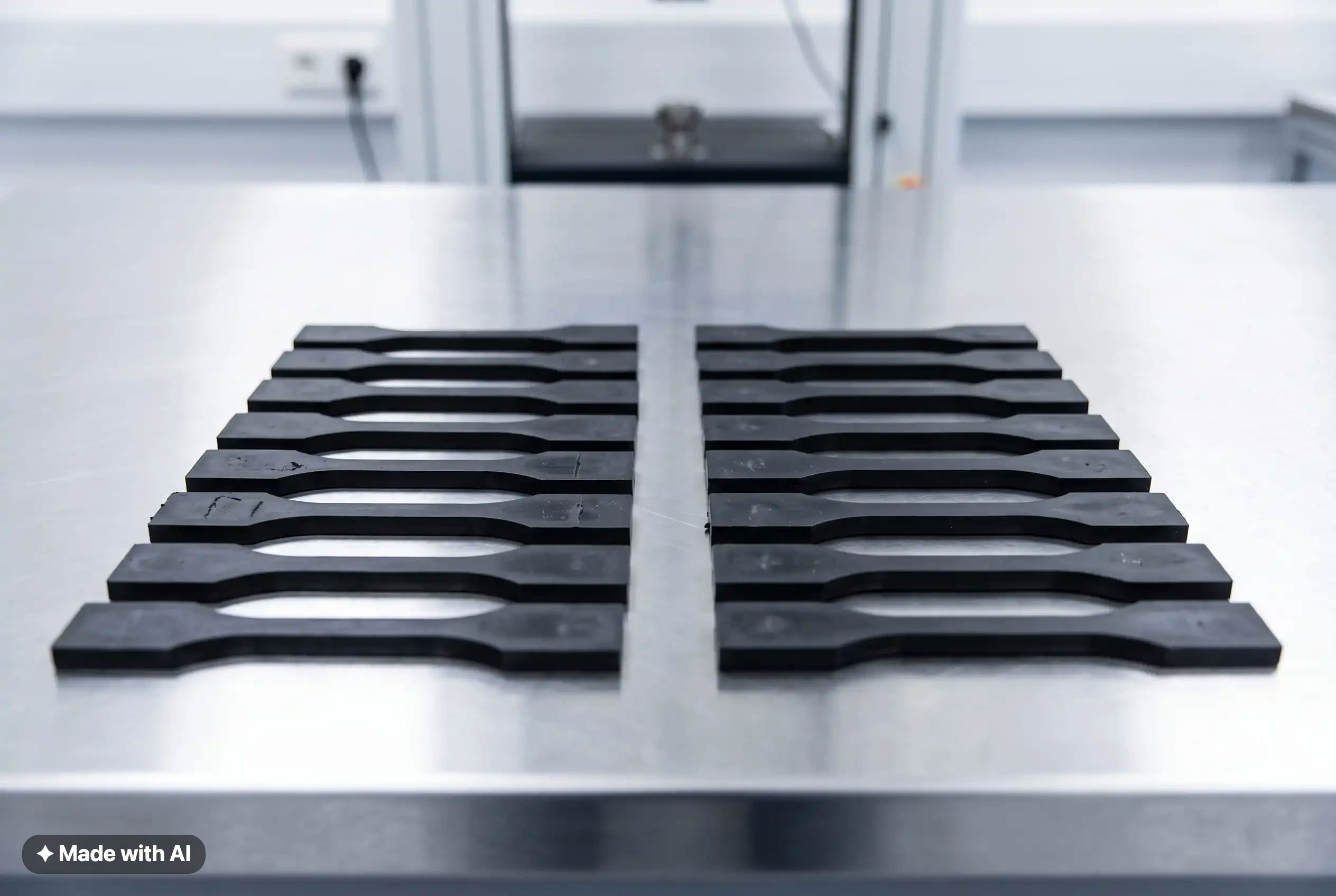
- Tensile strength – the maximum tensile force per unit area that a test specimen can withstand before breaking; determined in the tensile test
- Elongation at break / Elongation – the percentage change in length at break; characteristic of the material’s ductility
- Tear resistance – the resistance of a test specimen that has already been notched to further tearing; relevant for components subjected to dynamic loads
- Compression set – the permanent deformation remaining after sustained compression; a key parameter for long-term sealing performance
- Hardness (Shore A) – the resistance to penetration by a defined test specimen; influences installability, contact pressure and deformation behaviour under installation conditions
- Abrasion resistance – the resistance to mechanical wear caused by friction; particularly relevant for dynamic seals and moving components
Physical and chemical characteristics
In addition to mechanical properties, other characteristics determine the range of applications for an elastomer:
- Elasticity – the ability to recover after deformation – indicates how well a material returns to its original shape after the load is removed
- Chemical resistance – behaviour when exposed to media such as oils, fuels, acids, alkalis or water; assessed on the basis of volume swelling, changes in hardness and mechanical alterations following storage in the medium
- Operating temperature range – the limits within which an elastomer reliably retains its mechanical and sealing properties; influenced by the type of rubber, cross-linking system and plasticiser content
- Ageing behaviour – the change in properties over time and under the influence of heat, ozone, UV radiation and media; assessed through artificial ageing tests in a climatic chamber or ozone chamber
Compound control as the basis for quality
The property profile of a compound is only reproducible if the entire process chain – from raw material testing through compounding to vulcanisation – takes place under controlled conditions and with consistent raw materials. Fluctuations in raw material quality, compound viscosity or cross-linking behaviour are directly reflected in the component’s performance characteristics.
For this reason, professional compound control typically comprises three levels: incoming inspection of raw materials, rheometric testing of the unvulcanised compound (Mooney viscosity, vulcanisation characteristics) and mechanical testing of the finished vulcanised product using standardised test specimens. Only when all three levels confirm compliance with the specification is a compound deemed to have been approved.
Contact