
Elongation in elastomers
<p>Elongation describes the change in length of a material under mechanical or thermal stress, expressed as a percentage of its original length. In elastomer technology, elongation is one of the most important material properties: it provides information on how flexible and deformable an <a href="t3://record?identifier=tx_dpnglossary&uid=175">elastomer</a><strong> </strong>is – and thus, for which installation situations and types of load it is suitable.</p>
<p>Elongation (epsilon) is calculated using the formula: epsilon = (delta L / L<sub>0</sub>) × 100 per cent, where delta L is the change in length and L<sub>0</sub> is the original length of the test specimen.</p>
<h2>Elongation at break: the measure of the yield point</h2>
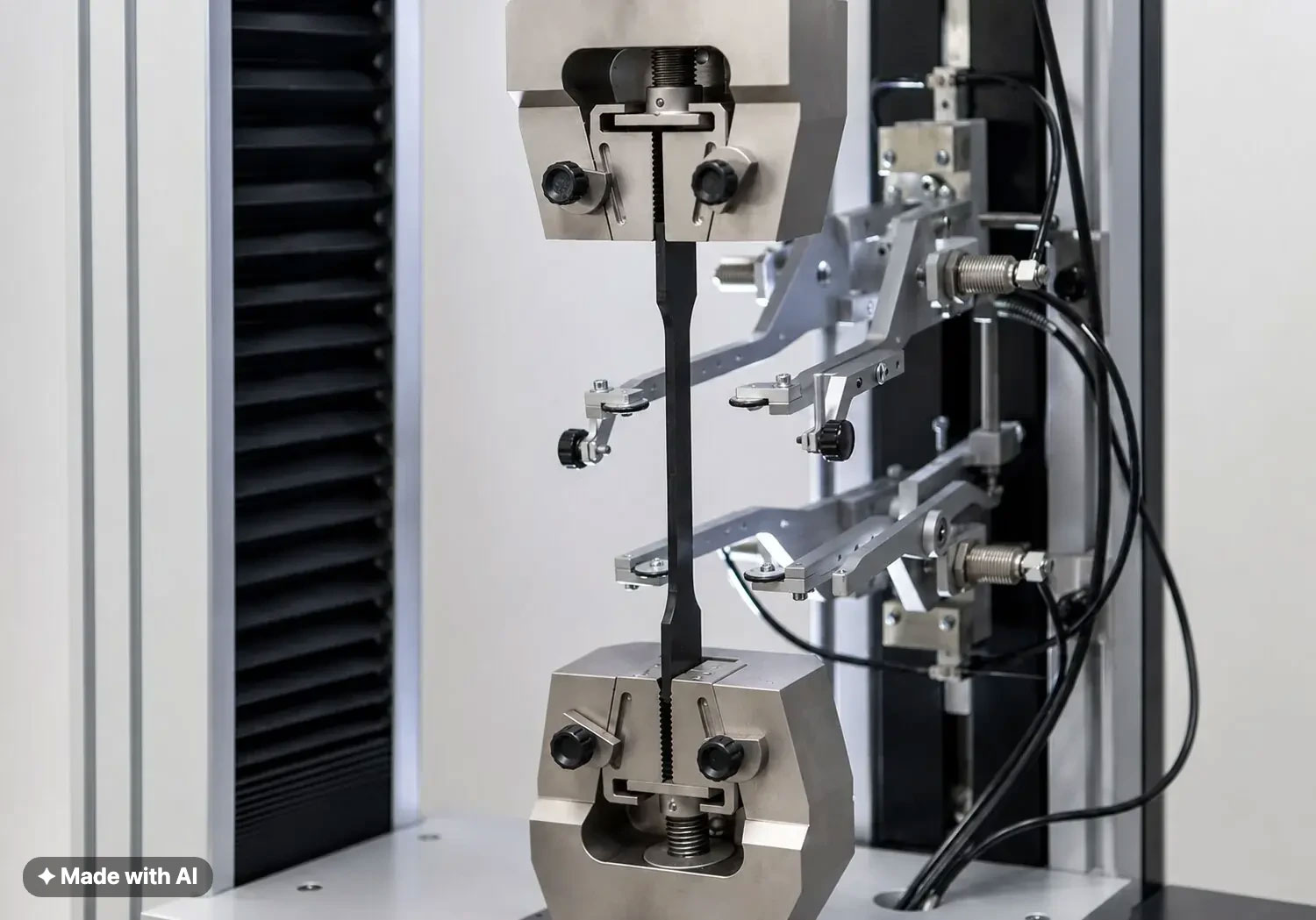
<p>A particularly relevant parameter in practical terms is the elongation at break (also known as the fracture elongation): it indicates the percentage elongation at which a test specimen fails under tensile load – i.e. tears. It is typically determined in a <a href="t3://record?identifier=tx_dpnglossary&uid=111">tensile test</a> on standardised test specimens (e.g. shoulder bars in accordance with DIN ISO 37).</p>
<p>Typical elongation at break values for elastomers range from 100 per cent to over 700 per cent, depending on the material and <a href="t3://record?identifier=tx_dpnglossary&uid=74">compound</a>. By way of comparison: steel typically elongates by only a few per cent before breaking. This enormous elasticity is one of the characteristic properties of rubber-based materials and makes them particularly suitable for sealing, damping and compensation applications.</p>
<h2>Thermal expansion</h2>
<p>In addition to purely mechanical elongation under load, temperature fluctuations also alter the dimensions of a component. The thermal expansion of elastomers is approximately a factor of 10 greater than that of metals.</p>
<p>This is significant in sealing applications involving fluctuating temperatures: An <a href="t3://page?uid=153">O-ring</a> or a <a href="t3://page?uid=254">profiled seal</a> fitted at low temperatures expands at operating temperature – which alters the installation compression and thus the contact force at the sealing point. This thermal factor must be taken into account when designing sealing points subject to large temperature fluctuations.</p>
<h2>Elongation in conjunction with other properties</h2>
<p>Elongation at break alone does not indicate how a material will actually fail in service. It is always a combination of several properties that is decisive:</p>
<ul>
<li><span><span><span><span><span><span></span></span><span><span><span><span><a href="t3://record?identifier=tx_dpnglossary&uid=94">Tensile strength</a> </span></span></span></span><span><span><span>– the force acting per original unit area at the point of rupture. Together with the elongation at break, this provides a complete picture of the failure behaviour</span></span></span></span></span></span></span></li>
<li><span><span><span><span><span><span></span></span><span><span><span><span><a href="t3://record?identifier=tx_dpnglossary&uid=118">Tear propagation resistance</a> </span></span></span></span><span><span><span>– the extent to which a test specimen that has already been notched resists further forces. Particularly relevant for components subjected to dynamic loads</span></span></span></span></span></span></span></li>
<li><span><span><span><span><span><span></span></span><span><span><span><span><a href="t3://record?identifier=tx_dpnglossary&uid=75">Deformation</a> </span></span></span></span><span><span><span>– whether the strain is reversible (elastic) or permanent (plastic) determines the long-term suitability of a sealing element</span></span></span></span></span></span></span></li>
</ul><p>High elongation at break, combined with good tensile strength and low <a href="t3://record?identifier=tx_dpnglossary&uid=120">compression set</a>, characterises a material that is mechanically robust, elastically resilient and therefore suitable for demanding sealing applications.</p>
Contact