
Chemical resistance
Chemical resistance refers to the ability of a material (e.g. elastomers such as EPDM, NBR, CR or plastics such as PTFE) to withstand a medium over a certain period of time without any unacceptable deterioration in sealing function and component properties.
In practice, chemical resistance lists – so-called media resistance tables – are frequently used for this purpose. They help designers and buyers to make an initial material selection – for example for O-rings, profiles, moulded parts or gaskets.
Important: such lists are a guide. The actual resistance always depends as well on temperature, exposure time, concentration, pressure, motion (static/dynamic) and on the specific compound.
How resistance lists are typically classified
Many tables categorise the behaviour of a material – frequently on the basis of the change in volume (usually volume swelling):
- Category 1 (very good): no to slight change, approx. 0–5 % change in volume
- Category 2 (good): slight to moderate change, approx. 5–10 %
- Category 3 (moderate): moderate to marked change, approx. 10–20 %
- Category 4 (poor / not recommended): strong reaction, use generally critical to unsuitable
- n. d.: no data available
This classification is a useful first filter – but not a verdict on actual suitability. A material may show a change in volume close to 0 % and yet be unsuitable if the medium attacks the chemical cross-links: the material then loses hardness and tensile strength without measurably swelling – it becomes soft and loses sealing force without the volume table raising any alarm. The assessment of resistance must therefore necessarily also include the change in mechanical characteristic values – in particular the change in hardness (guide value: max. ±10–15 Shore A) and tensile strength.
Volume swelling is helpful – but not the whole truth
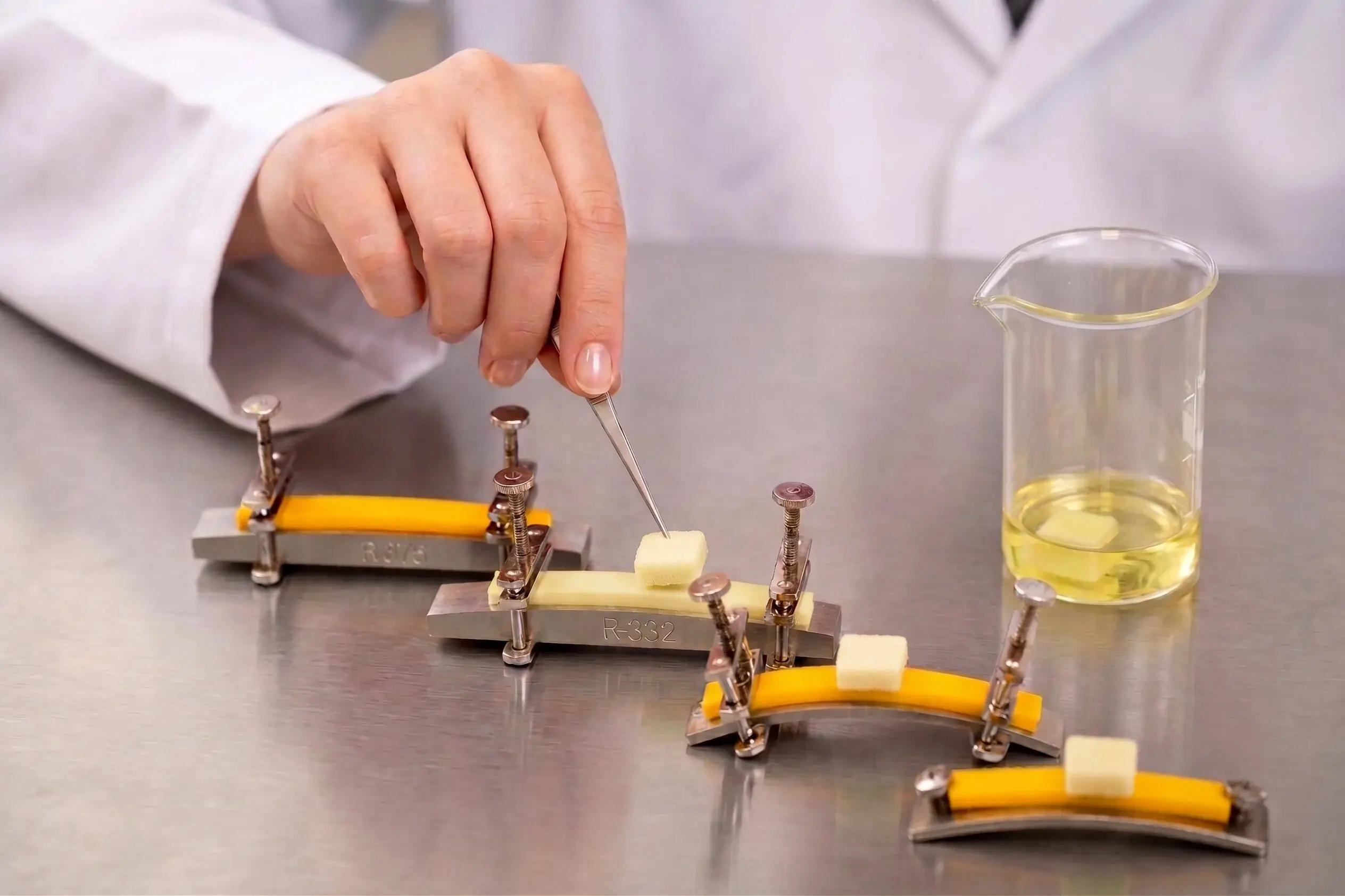
Volume swelling is a good indicator of whether a medium is absorbed by the material and the elastomer thereby "swells up". On its own, however, it does not tell you whether a seal will function durably. A material can become critical despite moderate swelling if characteristic values shift markedly – for example:
- change in hardness (softer or harder)
- decreasing tensile strength or elongation at break
- poorer tear propagation resistance
- change in compression set, recovery force and sealing compression
- increasing abrasion under motion
This is particularly decisive at dynamic sealing points (reciprocating or rotary motion): swelling can change the installation situation and, depending on the groove geometry, increase contact pressure and friction. This sometimes appears "tighter" in the short term, but in operation it often leads to more heat generation and thus to greater wear or faster ageing – right through to premature failure.
Swelling vs. shrinkage: why shrinkage is often more critical
In addition to swelling, there is also volume shrinkage. It frequently arises when a medium dissolves constituents out of the compound (e.g. plasticisers (https://kremer-tec.de/unternehmen/lexikon-elastomertechnik/glossar-begriff/weichmacher-93.html) or other low-molecular-weight fractions). Typical accompanying effects are an increase in hardness, greater stiffness and a poorer ability to adapt to tolerances.
For seals, shrinkage is often particularly tricky because it reduces the preload: an O-ring or profile seal then bears less snugly against its counterface – a leakage path forms more easily, especially during pressure changes or motion. Even a few per cent of shrinkage can become relevant in practice, depending on cross-section, groove and gap dimension. Blanket limit values (e.g. "3–4 %"), however, are only rough reference figures – what matters is the geometry and preload of the specific sealing point.
Particularly at risk are components exposed to changing media or maintenance cycles with dry periods. During contact with the medium, the seal swells and remains apparently tight. When the system is drained or the medium is changed, the true extent of the extraction becomes apparent: the seal shrinks below its original dimension and the preload collapses. The leakage does not occur during operation, but on the first restart after a maintenance break – a failure pattern that is difficult to diagnose without knowledge of this mechanism.
Which further factors act on chemical resistance
Many media are uncritical at room temperature, but become considerably more aggressive when heated. Likewise, a medium may be inconspicuous after a short time but show noticeable effects after weeks or months. The following therefore applies:
- High temperature » ageing, extraction and chemical reactions proceed faster
- Long exposure time » even small effects add up
- The compound is decisive » within the same material family (e.g. EPDM or NBR), different compounds can show markedly differing resistances (fillers, cross-linking, additives)
A further critical factor is additives within the medium. In industrial practice, one rarely deals with pure substances: modern gear oils, coolants and fuels contain anti-wear, anti-corrosion and viscosity additives. An FKM material can be excellently resistant to mineral oil as the base fluid – but if the same oil contains aggressive amines, the elastomer is attacked from the inside out.
The resistance table shows "very good", but in practice the result is failure. The compound must therefore always be tested against the overall medium including all additives, not against the pure substance.
What causes changes in volume
Changes in volume arise primarily through two mechanisms:
- Absorption/swelling: molecules of the medium penetrate the material, the elastomer takes up the medium and becomes softer or more voluminous.
- Extraction/shrinkage: constituents of the compound are dissolved out, the material becomes more compact and often harder.
In addition, media – depending on their chemistry – can also affect the polymer chain, the cross-linking system or the filler surfaces. In that case, not only the volume changes but also the mechanical behaviour.
Here you can access the interactiveresistance list: materials against chemicals
Contact