
ASTM (ASTM International)
ASTM International is an independent standards organisation operating worldwide. It develops voluntary consensus standards – that is, technical standards, test methods and specifications for materials, products and processes. The aim is comparability: when two laboratories test to the same ASTM standard, characteristic values such as tensile strength, hardnessor media resistance should be genuinely and reliably comparable.
Why is ASTM important in practice?
In engineering, we encounter ASTM primarily in the following areas:
- Material selection & specifications
Materials are described by means of minimum requirements defined in an ASTM standard (e.g. test set-up, specimen shape, evaluation). - Test reports & data sheets
Characteristic values are only meaningfully comparable if it is clear to which standard testing was carried out (e.g. hardness, tensile strength, compression set, oil resistance). - Quality assurance & incoming goods inspection
Tests follow standardised methods – enabling deviations to be identified reproducibly and documented cleanly.
Particularly in elastomer and sealing technology, for example with O-rings, profiles, moulded partsor seals, ASTM test standards are widely used – often alongside DIN/EN/ISO.
A brief background to ASTM
The organisation dates back to 1898; Charles Benjamin Dudley (Pennsylvania Railroad) is regarded as its instigator. The impetus came, among other things, from quality problems in the railway sector and the need for uniform material requirements. Since 2001, the organisation has officially borne the name ASTM International.
How many ASTM standards are there?
ASTM today cites more than 13,000 standards that are used worldwide.
Typical ASTM standards in elastomer and sealing technology
Some standards that frequently appear in specifications and test plans:
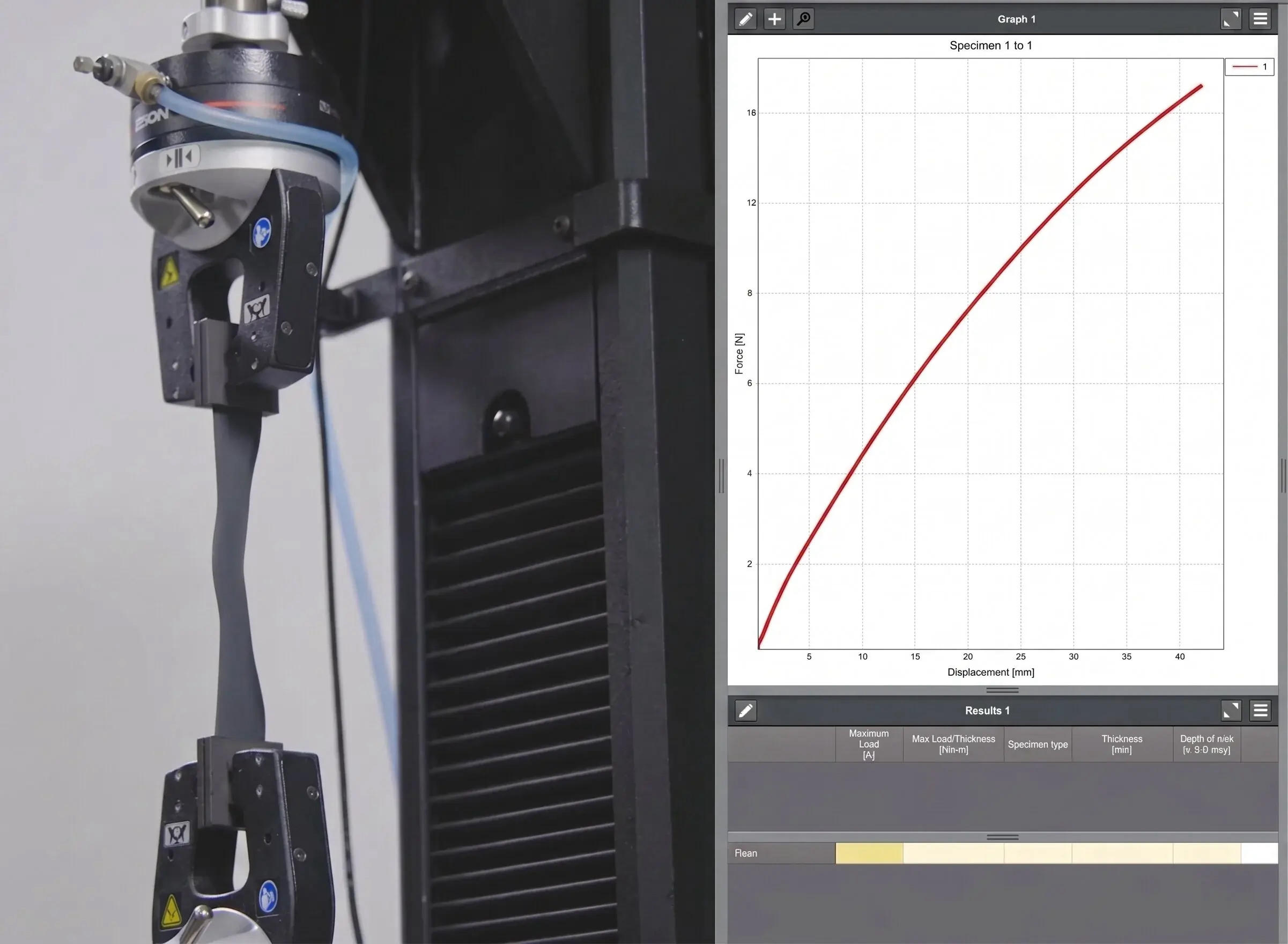
- ASTM D412 – tensile test on vulcanised rubber/TPE (tensile strength, elongation at break, moduli)
- ASTM D2240 – durometer/Shore hardness for elastomers and plastics
- ASTM D395 – compression set
- ASTM D471 – "Effect of Liquids" (changes caused by defined liquids, e.g. oils or fuels)
- ASTM D1149 – ozone testing (crack formation under a defined ozone exposure)
- ASTM D2000 – classification and call-out system for vulcanised rubber materials (frequently in the automotive sector)
Two points deserve particular attention: ASTM D2000 appears in specifications as a compact code – for example "M2-BG714-A14-B14".
The leading "M" in the code also signals that all requirements are given in the internationally defined units of measurement, the SI units – if it is absent, US units apply (psi, °F). Anyone who overlooks this and simply reads the numerical values as metric will specify a material with the wrong strength and temperature limits.
In this context, the abbreviation "BG" stands for the material family; the number "714" that follows specifies the property group, typically 70 Shore A with a minimum tensile strength.
The subsequent letter (Type) defines the temperature resistance: A stands for 70 °C, with the scale extending up to J for 275 °C. The second letter (Class) defines the oil resistance via the maximum permissible swelling in reference oil: A means no requirement, K stands for very low swelling. A "BG" material – typically NBR – therefore means: 100 °C heat resistance, medium oil resistance.
Finally, the designation "B14" sets out additional requirements from test group B, mostly relating to swelling behaviour in oils.
Without knowing how to read this code in full, one also lacks the knowledge of which material requirements a customer is actually setting.
ASTM D471, in turn, makes use of specific IRM reference oils (IRM 901, 902, 903), which are not identical to the ISO test oils to ISO 1817 – IRM 903 is more aggressive towards many elastomers than the comparable ISO oil No. 3. Swelling values from ISO tests cannot therefore be transferred directly to ASTM requirements.
Important for interpretation: two materials may appear "similar" – but temperature, test duration, specimen shape, extension rate or the reference liquid used determine whether values are genuinely comparable. This is precisely why the standard designation in the data sheet, drawing and test report is so valuable.
ASTM vs. DIN/EN/ISO – do you have to choose?
No. In many projects, ASTM and ISO/DIN/EN run in parallel. What matters is that drawings, specifications and test plans unambiguously stipulate which standard applies – and that characteristic values from different standards systems are not equated without careful consideration.
Two specific pitfalls: ASTM D412 uses different specimen geometries (e.g. Die C) than DIN 53504 (e.g. S2), which leads to systematically differing elongation-at-break values for an identical material. And tensile strength values in US data sheets are frequently given in psi – a value of 2,000 psi sounds high, but corresponds to only around 13.8 MPa. Anyone placing ASTM and ISO data sheets side by side should always reconcile units and test geometries first. Requirements, test results and approvals can then be cleanly traced.
- Material selection & specifications
Contact