
Fillers
Fillers are – alongside the rubber itself – the most important components of a rubber compound in terms of quantity. They are added specifically to control the processability, mechanical properties and functional behaviour of an elastomer – from hardness and abrasion resistance to electrical conductivity.
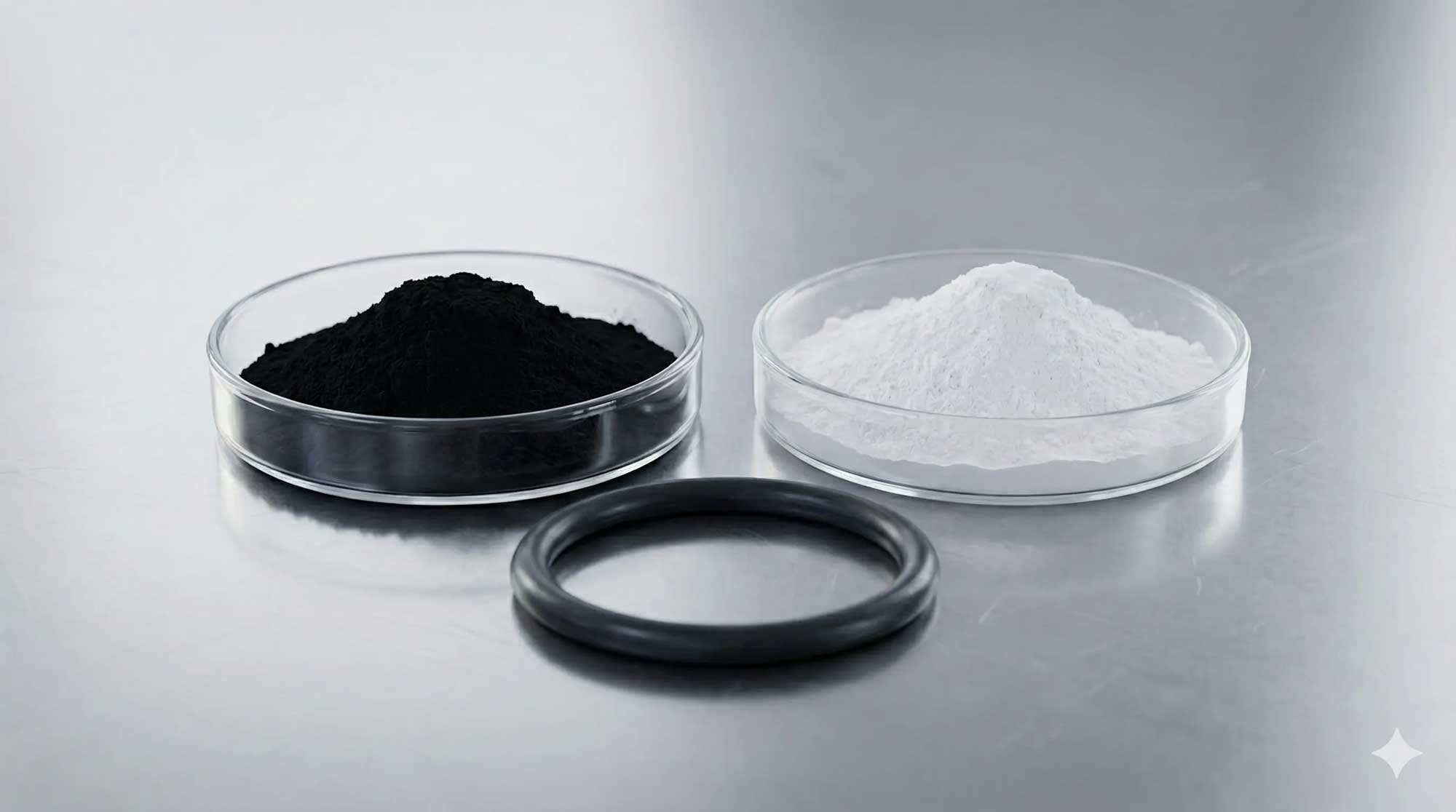
- Carbon black – reinforcing fillers for high tensile strength, abrasion resistance and crack resistance
- Filled and pyrogenic silica – reinforcing, often used in light-coloured compounds or in seals and tyre treads subject to high dynamic stress
- Mineral fillers such as talc, kaolin, chalk or barite – predominantly semi-reinforcing to inactive; they influence density, stiffness, dimensional stability and cost structure
Fillers characterise the central material properties of an elastomer. Among other things, they influence:
- Hardness (e.g. Shore A) and modulus
- Tensile strength, elongation at break and resistance to tear propagation
- Abrasion resistance and resilience
- Damping behaviour and compression set
- Processability of the compound (viscosity, flow behaviour during extrusion and injection moulding)
Depending on the type and quantity of filler, a rubber compound can be made softer or harder, more flexible or stiffer, more resistant to abrasion or more shock-absorbent. In many applications, fillers also help to improve heat ageing or media resistance, for example in seals, O-rings, profiles or moulded parts that must function reliably under pressure, temperature and chemicals. Conductive carbon black types and special fillers (e.g. graphite, metal or fibre fillers) play a special role: they can significantly increase electrical conductivity and are used in antistatic or conductive components, ESD profiles or safety-relevant seals.
Contact