
Compounding
Compounding refers to the manufacturing process of a rubber mix – that is, the step in which a processable material is created from a defined formulation of individual constituents. If the compound stands for the composition, compounding describes the process: the weighing-in, dosing and homogeneous mixing of all constituents under controlled conditions.
The result is an unvulcanised rubber mix, which is subsequently shaped by extrusion, injection moulding or compression moulding and then vulcanised.
Sequence of the compounding process
The process begins with the precise dosing of all formulation constituents:rubber, fillers, plasticisers, anti-ageing agents and cross-linking chemicals are weighed in according to the specification of the formulation. Deviations – even in the range of tenths of a per cent – can measurably influence the subsequent material properties.
The actual mixing takes place in two common types of machine:
Internal mixer (kneader): the rubber and the main constituents are kneaded together in a closed mixing chamber under pressure and heat. Internal mixers enable intensive, reproducible blending and are preferred in series production. Typical mixing temperatures lie between 80 °C and 160 °C, depending on the rubber type and formulation. The friction heat generated in the process must be actively dissipated by cooling the mixing chamber: if the temperature rises in an uncontrolled manner, the cross-linking system reacts while still in the kneader – the entire batch pre-vulcanises and is unusable.
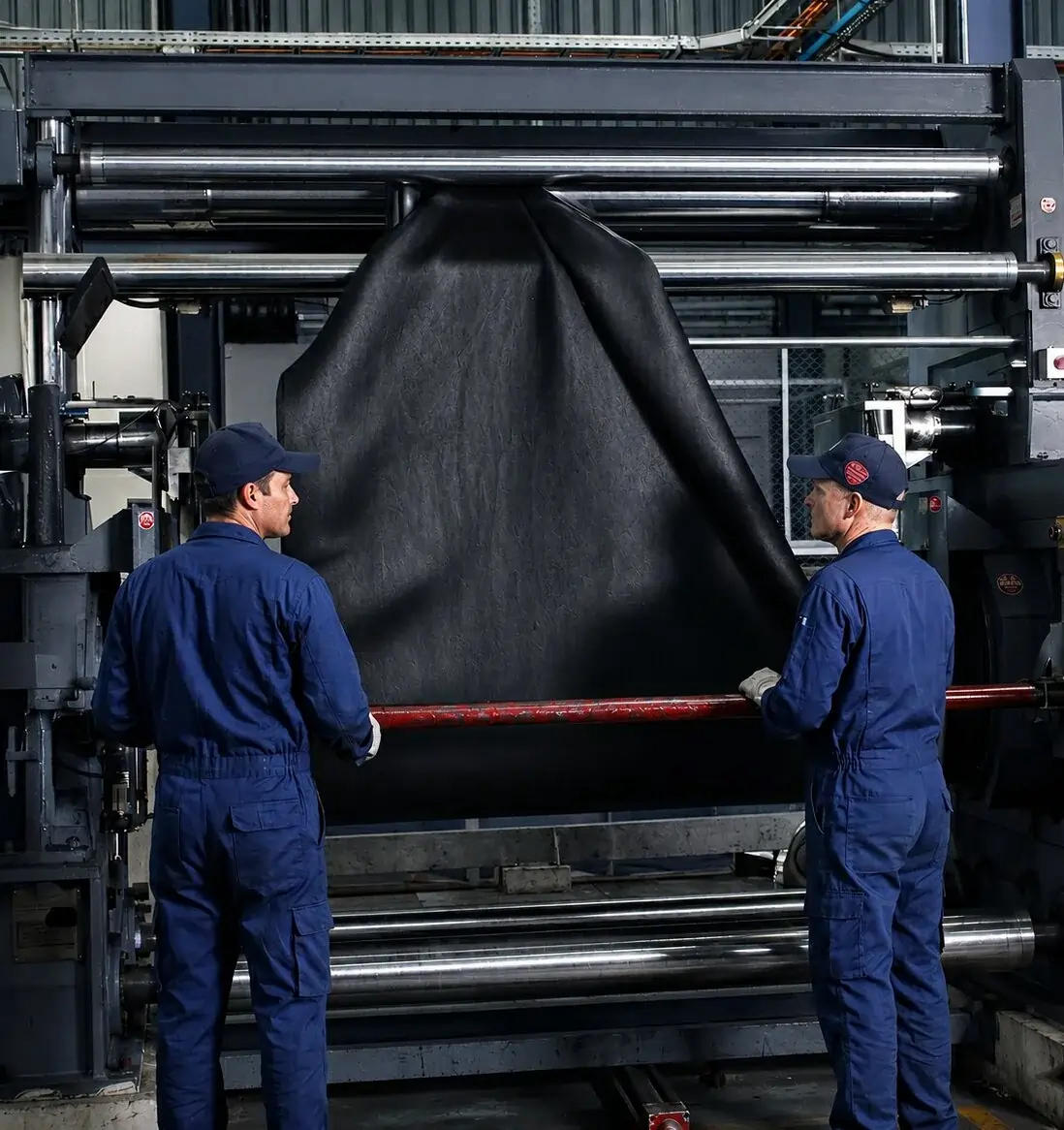
Roller mill (open mill): two counter-rotating, usually water-cooled rollers plasticise and homogenise the mixture. Since the high shear forces during kneading generate considerable friction heat, the roller temperature must be strictly controlled – especially because it is typically on the roller mill that the heat-sensitive cross-linking system is added. The roller mill is particularly suitable for the fine-tuning of the mixture and for smaller batches.
In practice, the two processes are frequently combined: the internal mixer takes on the main mixing stage, the roller mill the finishing and the incorporation of the cross-linking system.
Why process control determines the material properties
Compounding is not a pure mixing process – it is a reactive process. Temperature, mixing time and shear energy influence how well fillers are distributed within the rubber, how strongly the rubber is broken down mechanically (mastication) and whether cross-linking reactions set in prematurely and unintentionally – known as pre-vulcanisation or scorch.
Fillers such as carbon black and silica are present in their raw state as agglomerates – compact clusters of particles that are not broken up by mere distribution. It is only the high shear forces in the internal mixer that break these agglomerates down and bring the filler into close contact with the polymer chains (dispersion). Without this fine distribution, fillers do not develop their reinforcing effect – tensile strength and abrasion resistance remain far below the achievable level.
Cross-linking agents and accelerators, by contrast, may only be incorporated at lower temperatures, in order to ensure a controlled vulcanisation only in the downstream process step.
The quality of the compounding thus directly determines whether an elastomerreproducibly achieves the required characteristic values in the subsequent application – whether an O-ring has the specified hardness, whether a profile seal shows the desired low-temperature flexibility or whether a moulded part keeps within the compression set.
A further process risk is cross-contamination: residues of a sulphur cross-linking system from a previous batch can chemically disrupt the cross-linking system in a subsequent peroxide-cured FKM or FPM mix and render the batch unusable – and this even in the gram range. Single-grade process control and defined cleaning cycles between incompatible compounds are therefore not optional quality measures, but mandatory.
From the compound to the processable mixture
After the mixing process, the compound is typically present as a sheet (milled sheet) or as a strip. Both extrusion lines and injection moulding machines are generally fed with continuous strips (feed strips), less often with pre-plated batches. Granulate hardly occurs in classic elastomer technology – it is reserved for thermoplastic elastomers (TPE).
For safety-critical components such as thin diaphragms or precision O-rings, the finished compound is additionally strained: by pressing it through a fine sieve, undispersed particles and impurities are removed that would later lead to defects in the component. Straining is the final step before release for shaping and a prerequisite for a zero-defect strategy with high-quality parts.
Before use in production, samples of the mixture are tested – typical are rheometer measurements to DIN ISO 6502, which characterise the vulcanisation behaviour of the mixture, as well as raw-mix tests for viscosity (Mooney viscosity to DIN ISO 289). Only upon release does the mixture go into shaping.
Contact