
Elasticity in elastomers
Elasticity refers to a material’s ability to return completely to its original shape following mechanical stress. The energy applied is stored in the process and released again when the load is removed – the material ‘springs’ back. In elastomer technology, elasticity is not merely a material property, but the fundamental prerequisite for seals, dampers and spring elements to be able to fulfil their function over the long term.
Linear-elastic and non-linear-elastic behaviour
In materials science, a distinction is made between two fundamental forms of elasticity:
In the case of linear-elastic behaviour, a material deforms in proportion to the applied load – if the force doubles, the deformation doubles. This behaviour is described by Hooke’s law and applies to elastic bodies, such as metal rods, springs or ceramics, in the lower load range.
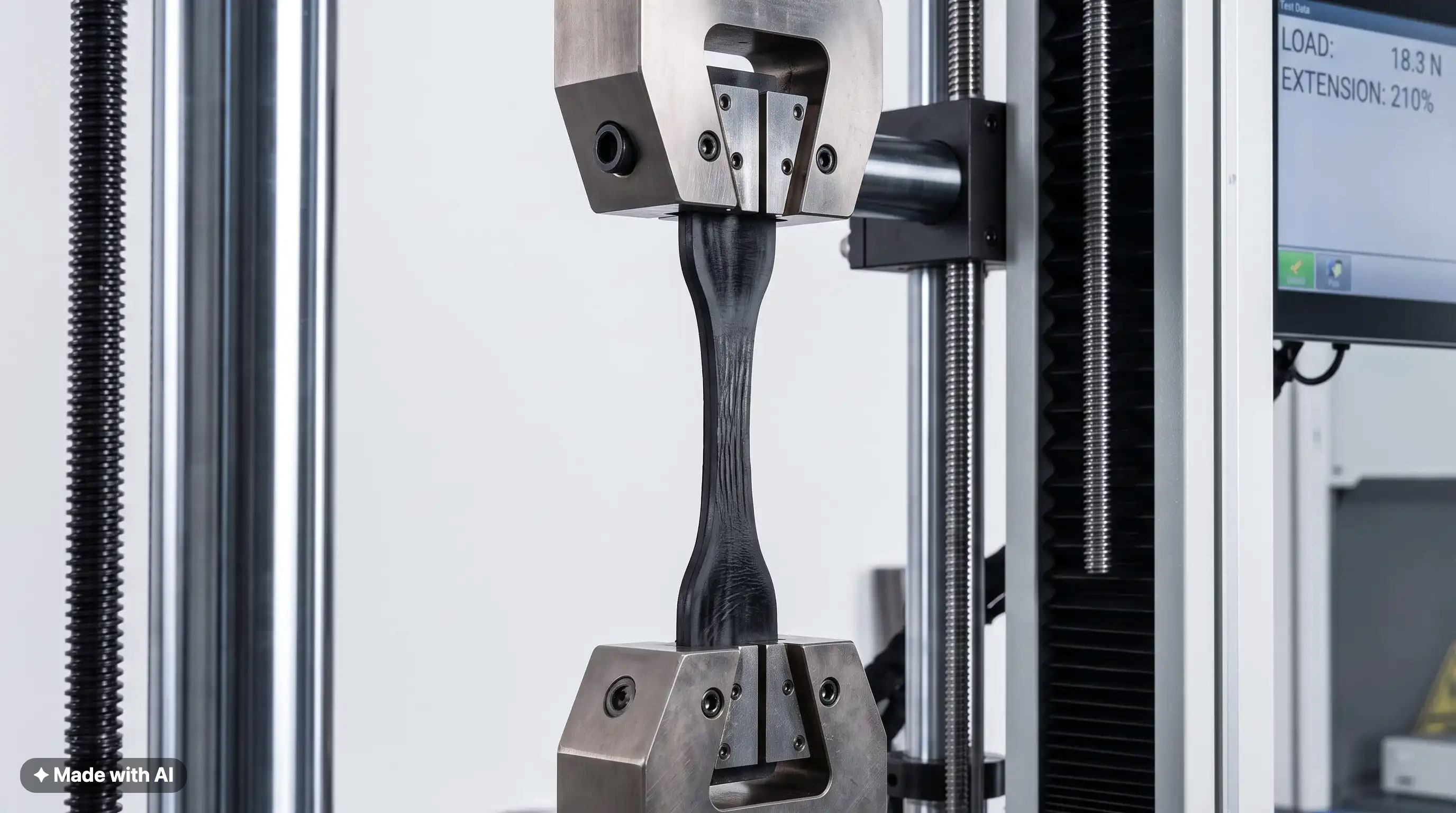
Elastomers, however, follow a different principle: they exhibit non-linear elastic behaviour, also known as rubber elasticity. For small deformations, the restoring force initially increases moderately; for larger deformations – when the polymer chains are stretched more strongly – the stiffness increases significantly.
The stress–strain curve of an elastomer is therefore characteristically S-shaped. This allows for high extensibility coupled with a progressive increase in force – a behaviour that is specifically utilised in many applications in sealing and damping technology.
Rubber elasticity: a molecular phenomenon
The reason for this behaviour lies in the molecular structure of rubber: long, flexible polymer chains are statistically entangled in their unloaded state. Under tensile load, they stretch – in an entropic elastic manner, rather than an energy-elastic one as with metals. The cross-linked polymer network, which is formed during vulcanisation, limits the maximum stretchability of the chains and ensures that the restoring force is maintained.
This entropy-based elasticity also explains a distinctive feature that distinguishes elastomers from metals: the stiffness of rubber increases as the temperature rises – whereas with metals, the opposite is true. A heated elastomer contracts more strongly when stretched than a cold one. This is known as the Gough–Joule effect.
Elasticity and viscoelasticity
No real elastomer is purely elastic. In fact, all rubber materials exhibit viscoelastic behaviour: in addition to the elastic component, which stores energy reversibly, there is a viscous component that dissipates part of the energy as heat. This hysteresis is the reason why elastomers not only absorb vibrations and impacts but also dampen them.
The extent of this damping – the so-called loss factor – depends on the material and temperature. In sealing technology, a high elastic component is desirable: an O-ring seal should retain as much of its initial preload as possible throughout its entire service life. The compression set is the practical parameter that indicates how much of the elastic restoring force remains after prolonged loading and exposure to heat.
Elasticity as a design criterion
When selecting the correct material and compounds, elastic behaviour is relevant in several respects:
- Sealing applications require sufficient elasticity to compensate for manufacturing and assembly tolerances and to maintain a permanent seal against the sealing surface even during temperature fluctuations
- Damping and bearing elements utilise the typical viscoelastic behaviour of elastomers – they combine elastic recovery with a viscous component, whereby kinetic energy is specifically converted into heat to reduce vibrations
- Dynamically loaded seals – for example, in hydraulic cylinders or rotating shafts – must retain their elastic properties over many load cycles without suffering fatigue or damage caused by heat build-up
The elasticity of an elastomer depends largely on the type of rubber, the cross-linking density and the filler package – and changes with temperature, ageing and deformation. Materials with excellent resilience across a wide temperature range – such as peroxide-cured EPDM or FKM, or FPM – are therefore in demand for demanding continuous-service applications.
Contact