
Anti-aging agents
In the context of elastomers, ageing describes the gradual process by which they lose their physical and chemical properties over time, in particular their elasticity and flexibility. This process – which, much like abrasion, has a decisive influence on the performance and service life of elastomer components – results on the one hand from a combination of external factors. These include temperature, UV radiation, ozone and chemical substances. On the other hand, the material's intrinsic properties also drive the ageing process – such as the molecular structure or the additives within the material.
Causes of ageing
The ageing of elastomers is a complex process. Understanding these ageing mechanisms is crucial for the selection and use of elastomers in demanding applications. From material selection and compounding through to component design, targeted measures can thus be taken to extend the service life of elastomer components across their entire period of use.
Thermal loads play a significant role in ageing. Elevated temperatures accelerate chemical reactions within the elastomer, in particular thermal oxidation. This leads to a degradation of the polymer chains, which manifests itself in a deterioration of the mechanical properties. This aspect must be given particular consideration when designing seals or moulded parts for high-temperature applications.
Oxidative processes, triggered by contact with atmospheric oxygen, present a further challenge. These reactions attack the polymer chains and can break them apart, resulting in significant weakening of the material. Unsaturated elastomers such as NR or SBR are particularly susceptible to this and often require the use of special antioxidants.
UV radiation initiates photochemical reactions in elastomers that lead to the formation of free radicals. These radicals can in turn break apart or cross-link polymer chains, which in practice results in embrittlement and material breakdown. In outdoor applications, for example with profile seals or bellows, UV resistance is therefore a critical factor.
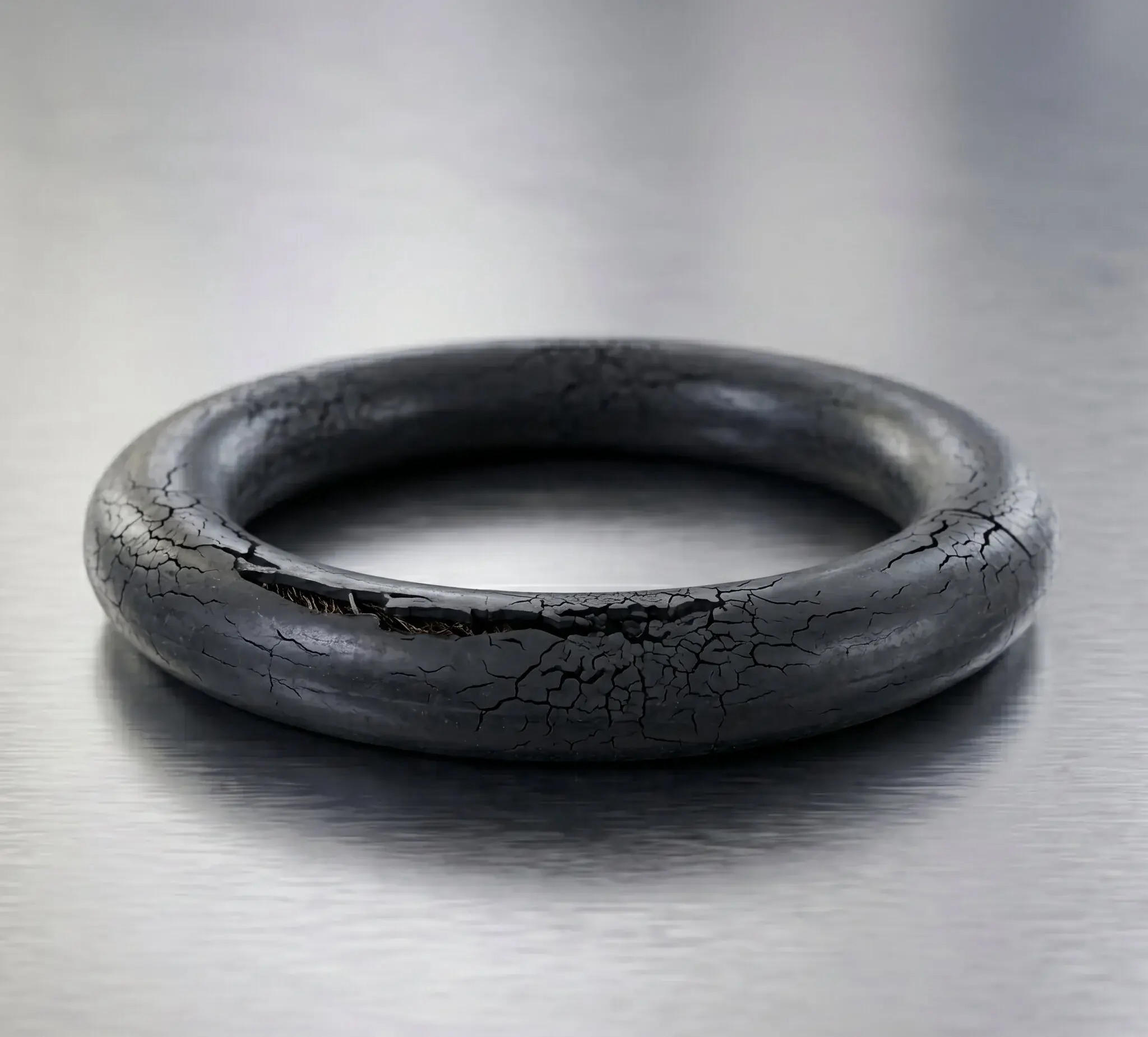
Ozone exposure and its consequences are likewise frequently underestimated. Particularly in the case of unsaturated elastomers such as NR, SBR or BR, it leads to accelerated ageing. Ozone attacks the double bonds in the polymer chains, resulting in cracking and embrittlement. This phenomenon, known as ozone cracking, is especially important to consider for elastomer components used outdoors and often requires the use of special anti-ozonants or the choice of ozone-resistant materials such as EPDM or FKM.
Chemical influences from aggressive media such as acids, alkalis or solvents can cause lasting damage to the polymer structure. Selecting an appropriately chemically resistant elastomer – for example FKM for mineral-oil environments or EPDM for use in environments exposed to brake fluids – is essential for the long-term stability of the material.
Mechanical stresses, in particular cyclic loading, lead to fatigue phenomena in the elastomer. The formation of micro-cracks, which grow over time, can ultimately result in failure of the component – for example in dynamically loaded components such as bellows. These have to withstand repeated stretching and compression, so that the correct material selection and design, taking mechanical ageing into account, is decisive here for a long service life and reliable function.
Signs and effects of ageing in elastomers
What applies to human life is, to a certain extent, also true of elastomers: ageing does not happen overnight – it is a progressive process. It manifests itself in various forms that can impair the functionality and reliability of the components.
One of the most common effects is an increase in the hardness of the material. The elastomer loses its flexibility, becomes more brittle and shows a reduced ability to adapt to deformation. This can be particularly problematic in sealing applications, as the sealing effect diminishes.
Alongside this hardening, there is often a reduction in tensile strength and elongation at break. The material becomes more susceptible to cracking and can break more easily under load. Fine cracks can form on the surface, spreading over time and potentially leading to material failure.
Another visible consequence of ageing is changes in colour. These can range from slight discolouration to pronounced yellowing or browning. Although changes in colour do not always directly affect the mechanical properties, they are an indicator of chemical changes within the material.
In the course of ageing, many elastomers also tend to undergo dimensional changes. They may shrink or swell, which can cause considerable problems in precision applications. In the case of dynamically stressed components, increased abrasion can also occur, further shortening the service life.
Methods for slowing ageing in elastomers
Fortunately, elastomers are not defenceless against the ageing process – the right handling makes the difference. This begins, for example, with correct storage of the components: cool, dry and dark environments slow the ageing process considerably. Extreme temperature fluctuations and direct sunlight should be avoided in the process. Controlling the humidity is equally important. It should be neither too high nor too low, in order to protect the material from drying out or from the promotion of oxidation processes. In addition, during storage, elastomer components must be kept away both from chemical substances and from ozone sources – such as motors, welding equipment or UV lamps.
Where contact with chemicals or other aggressive media is unavoidable during use of the elastomer product, special coatings or the choice of more resistant elastomer types can provide a remedy. In some cases, the use of protective housings or shielding is also worthwhile in order to minimise the impact of harmful environmental influences.
Measures can also be taken as early as the compounding of the elastomer: the use of anti-ageing agents such as antioxidants, UV stabilisers or anti-ozonants can markedly increase resistance to the various ageing mechanisms. The choice and dosage of these additives must be carefully matched to the particular application. One example of an additive that can be added during compounding is special anti-ozonant waxes. The wax migrates to the surface of the elastomer and forms a protective layer there. This layer then reacts preferentially with ozone and thus absorbs the greater part of the ozone exposure, thereby protecting the underlying elastomer from direct ozone attack. In this way, the wax bears the main burden of the ozone reaction and ultimately contributes to extending the service life of the elastomer.
For critical applications, regular monitoring of the components is advisable. Through cyclic inspections and measurements, signs of ageing can be detected at an early stage and countermeasures initiated. This can range from simple visual checks through to complex materials-engineering investigations.
Contact