
Compound
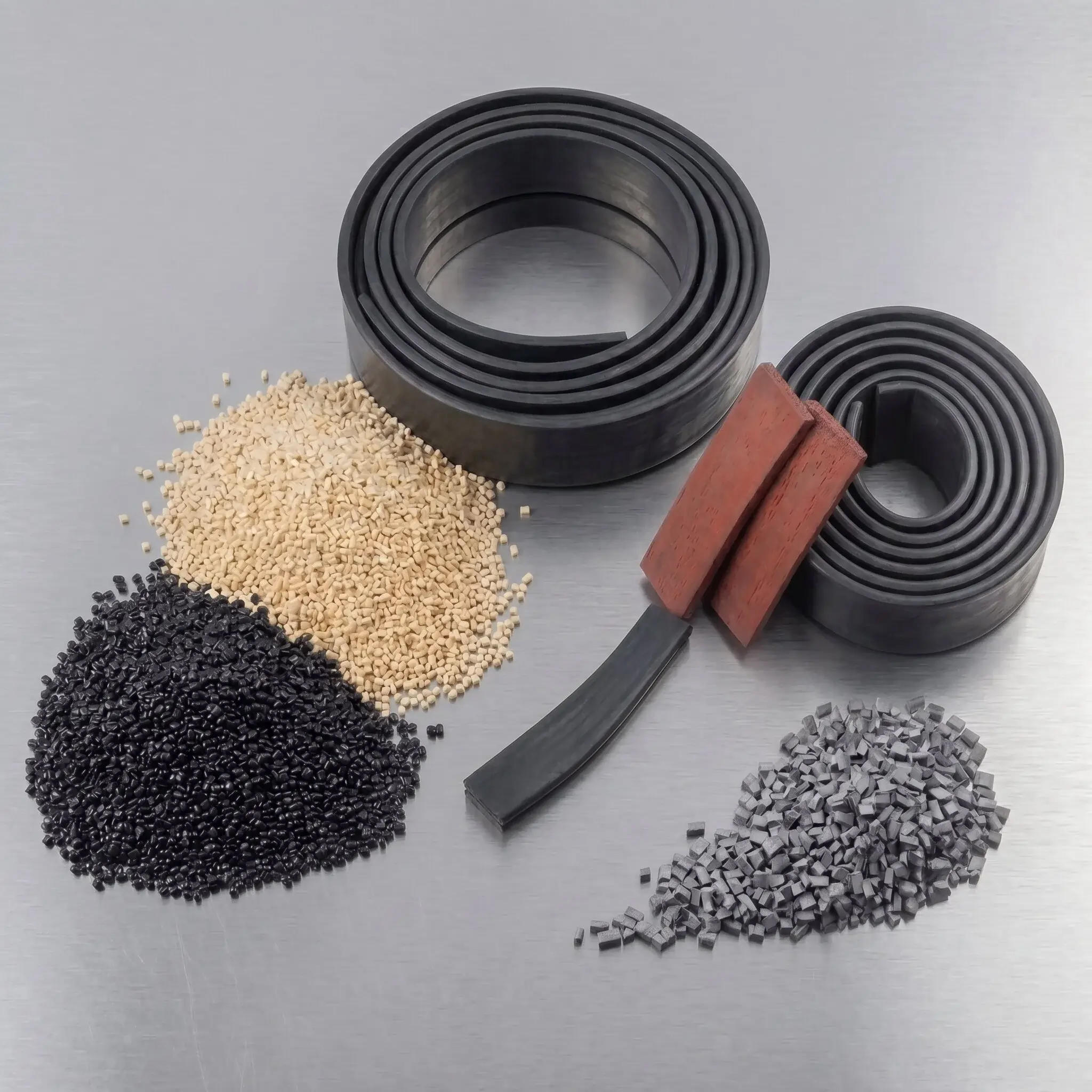
A compound – also known in German-speaking regions as a rubber mix or elastomer mix – is a precisely balanced formulation of rubber and various additives. It is only through this composition that the raw material rubber is turned into a technical material with defined properties: an elastomer designed for a specific application.
The term describes both the still unvulcanised mixture and – in the broader sense – the finished vulcanised material. In the technical context of sealing and elastomer technology, compound is frequently used as a synonym for a material-specific rubber mix that serves as the basis for O-rings, seals, profiles or moulded parts.
Constituents of a rubber mix
A compound typically consists of several constituents whose type and dosage determine the subsequent property profile of the elastomer:
- Rubber – the elastic base framework of the mix; depending on the type (e.g. NBR, EPDM, FKM, CR, VMQ) it determines the basic characteristics of the material: media and temperature resistance, elasticity, ageing behaviour
- Fillers – not mere extenders, but active reinforcers: most synthetic rubbers have hardly any mechanical strength without fillers. It is only the interaction between the polymer and a reinforcing filler – typically carbon black or silica – that generates the tensile strength and abrasion resistance which make a technically usable material.
- Plasticisers – influence low-temperature flexibility, hardness and processability; they lower the glass transition temperature and keep the elastomer elastic even at low temperatures
- Cross-linking chemicals – control the type and density of the cross-linking during the vulcanisation process; the choice between sulphur and peroxide cross-linking considerably influences, for example, the compression set and the temperature resistance
- Anti-ageing agents – protect the elastomer against ozone, UV radiation, heat and oxygen; decisive for long-term stability
- Processing aids – improve flow behaviour, demoulding and surface quality during extrusion or injection moulding
- Pigments and functional additives – for colouring, electrical conductivity, flame retardancy or food-contact suitability, among other things
Why the formulation is so complex
At the level of the raw materials alone, there are around 25 different rubber types, a wide variety of fillers and over 100 anti-ageing agents and cross-linking chemicals to choose from. Each component influences several properties at the same time – and the interactions between the constituents are considerable. Adjusting the plasticiser dosage changes not only the hardness, but also the low-temperature behaviour, the migration behaviour and the processability. A different filler combination may improve the tensile strength, but at the same time restrict low-temperature flexibility.
In addition, compounds within the same rubber base can differ greatly from one another. Two NBR compounds with different cross-linking systems or filler packages behave markedly differently in practice – in swelling, in compression set, in temperature resistance. Resistance lists therefore provide only an initial guide; the specific behaviour always depends on the particular compound.
From the mix to the finished component
The unvulcanised compound is first prepared homogeneously in an internal mixer or on a roller mill – and must be stored cool and dark until processing. Unlike thermoplastic granulate, it is chemically unstable: heat or an excessively long storage time triggers premature cross-linking, the so-called scorch or pre-vulcanisation. A pre-vulcanised compound cannot be returned to its original state and is thus unusable.
The actual processing takes place by extrusion, injection moulding, compression moulding or transfer moulding – after which the component vulcanises under heat: the cross-linking chemicals react and form a stable, three-dimensional polymer network that gives the elastomer its characteristic recovery capability. This step is irreversible – unlike a thermoplastic, a vulcanised elastomer cannot be melted down or reshaped.
The result is referred to as a vulcanisate – the finished rubber material with its tested properties such as Shore hardness, tensile strength, elongation at break, compression set and media resistance.
Significance in component design
For designers and buyers, the compound is the decisive variable behind a component: not every NBR O-ring is the same. Not every EPDM profile seal behaves identically under steam. The actual in-service properties – temperature resistance, media compatibility, long-term tightness – result from the specific mix, not from the rubber type alone.
The most important quality-assurance instrument for this is batch testing by means of a rheometer: during the test, the rheometer curve quickly reveals whether the compound as delivered actually possesses the required cross-linking and processing properties. In elastomer processing, testing compounds by means of a rheometer is one of the most important release tests and ensures the reproducibility of the subsequent component properties.
Contact