
Pressure resistance of elastomers
The resistance that a substance offers to high pressures . Natural rubber has an extremely small spatial compressibility. When a compressive force acts on rubber, which is able to deform in all directions, it undergoes a deformation , building up energy. If the deforming force is removed, the rubber returns to its original position for the most part. The difference escapes as heat.
Due to these special properties of rubber, it has been developed in many areas to dampen vibrations and
Compressive strength describes a material’s resistance to external compressive loads – in other words, its ability to maintain its function when subjected to compressive forces without suffering permanent failure. In elastomer technology, this term is closely linked to a physical characteristic of rubber: elastomers are practically incompressible. Their volume can hardly be reduced by pressure – instead, the applied force leads to deformation, in which the material yields laterally.
How elastomers react to compressive loads
If a compressive force acts on an elastomeric component that can deflect freely in all directions, it deforms – whilst simultaneously storing elastic energy. When the load is removed, the material largely returns to its original shape. A small proportion of the energy applied is dissipated as heat; this effect is due to the viscoelastic behaviour of rubber and explains why elastomers not only absorb impact energy but also dampen it.
This is precisely where the technical benefit lies: elastomers absorb peak forces and convert part of them into heat, rather than rigidly transmitting them. This makes them one of the most important materials for damping and mounting applications in mechanical engineering and vehicle construction.
Limited ability to deflect: the critical case
The key factor determining behaviour under pressure is whether the elastomer can deflect freely or not. In a confined installation space – such as a fully filled groove – hydrostatic back pressure builds up during compression, as lateral deflection is not possible. In this case, the contact pressures rise sharply.
For seals, this is an effect that is deliberately utilised: the compression of an O-ring within its groove generates precisely this increased contact pressure at the sealing surfaces, thereby achieving the sealing effect. At the same time, two risks lurk in the design: if the clearance within the groove is completely exhausted – for example, due to a groove that is too narrow or an increase in volume resulting from thermal expansion or swelling – the incompressible material can build up enormous forces which, in extreme cases, may even damage the surrounding housing (groove overfilling). On the other hand, if the clearance dimensions are too large and system pressures are high, there is a risk of so-called gap extrusion: the elastomer is pressed into the sealing gap, shears off there and loses its sealing function.
Pressure resistance in material selection
The pressure resistance of an elastomer depends largely on the compound – specifically on its cross-linking density, filler composition and hardness. Harder compounds (higher Shore A values) deflect less under the same compressive force, generate higher counterforces and are therefore better suited to high-pressure applications. Softer compounds adapt better to uneven surfaces, but are more susceptible to gap extrusion at high system pressures.
Another parameter closely linked to pressure resistance is the compression set: This indicates the amount of permanent deformation remaining after prolonged compression – and thus how well an elastomer retains its restoring force and sealing performance over its service life.
Typical applications where pressure resistance is required
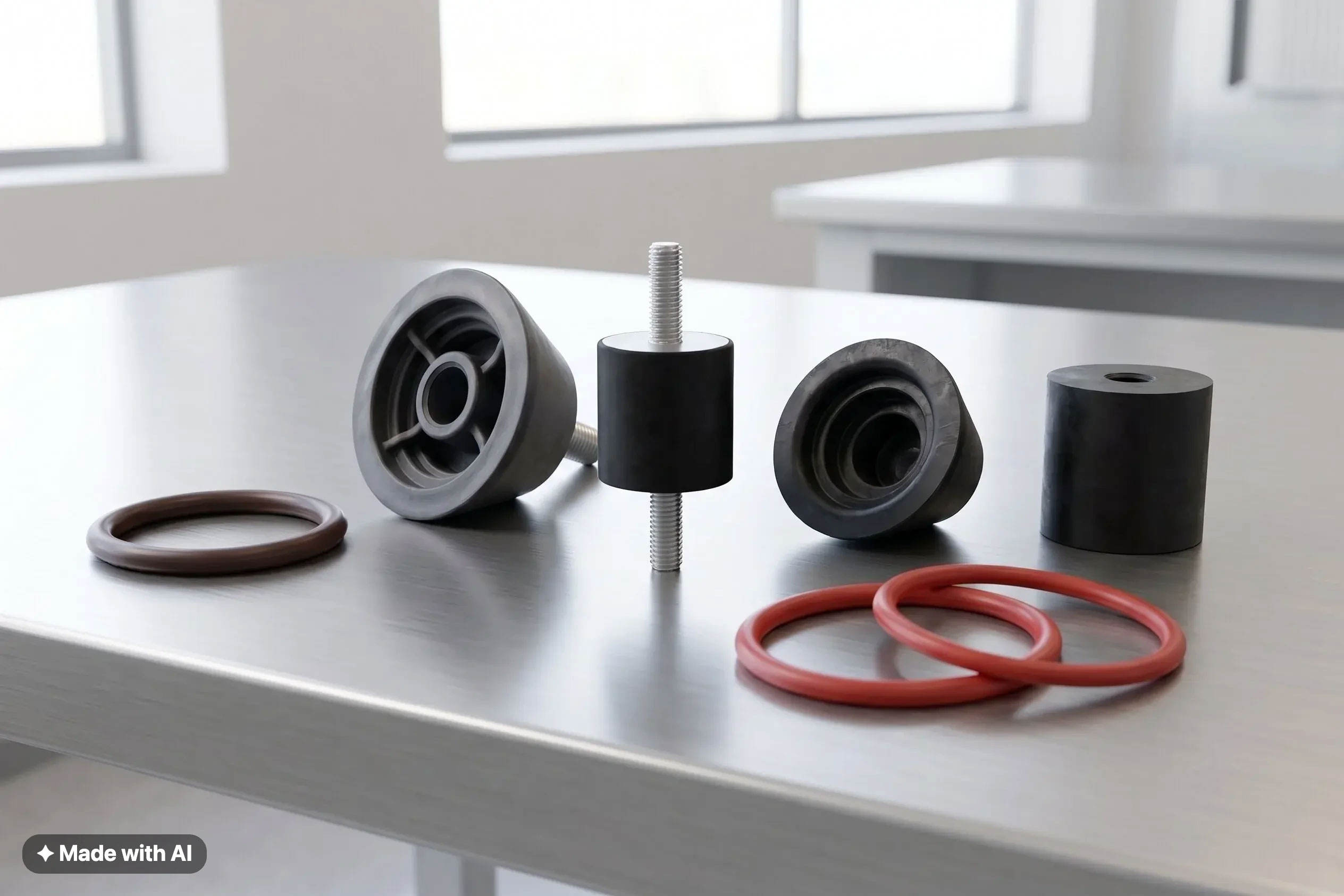
The combination of incompressibility, elastic energy storage and damping capacity makes elastomers the first choice in applications where compressive forces need to be absorbed, distributed or dampened:
- Engine mounts and machine mounts – vibration decoupling between the unit and the frame, damping of impact loads
- Buffers and stop elements – Absorption of end-position forces in machinery, vehicles and conveyor systems
- Hydraulic and pneumatic seals – O-rings, flat seals and moulded parts under static and dynamic system pressure
- Vibration dampers in automotive engineering, rail vehicle construction and general mechanical engineering
absorb shock loads, such as in engine and machine bearings.
Contact