
Deformation of elastomers
Deformation refers to the change in shape of a component or material under mechanical stress – caused by tension, compression, shear or torsion. In elastomer technology, deformation behaviour is a key design criterion: a sealmust deform in a controlled manner under installation pressure in order to close sealing gaps – at the same time, it must reliably return to its original shape once the load is removed in order to remain permanently sealed.
A distinction is made between two fundamental forms of deformation.
Elastic deformation
In elastic deformation, the material deforms under load and returns completely to its original shape once the load is removed. The deformation is reversible. This behaviour is the fundamental prerequisite for the use of elastomers as sealing materials: an O-ring or a profiled seal will only function reliably in the long term if the applied compression is elastically stored and transferred to the sealing surface as a restoring force.
Elastomers do not exhibit ideal-elastic behaviour like spring steel, but rather viscoelastic behaviour: part of the energy applied is dissipated as heat, and the material exhibits hysteresis. This explains why elastomers can dampen vibrations and why their recovery is temperature- and time-dependent.
Plastic deformation
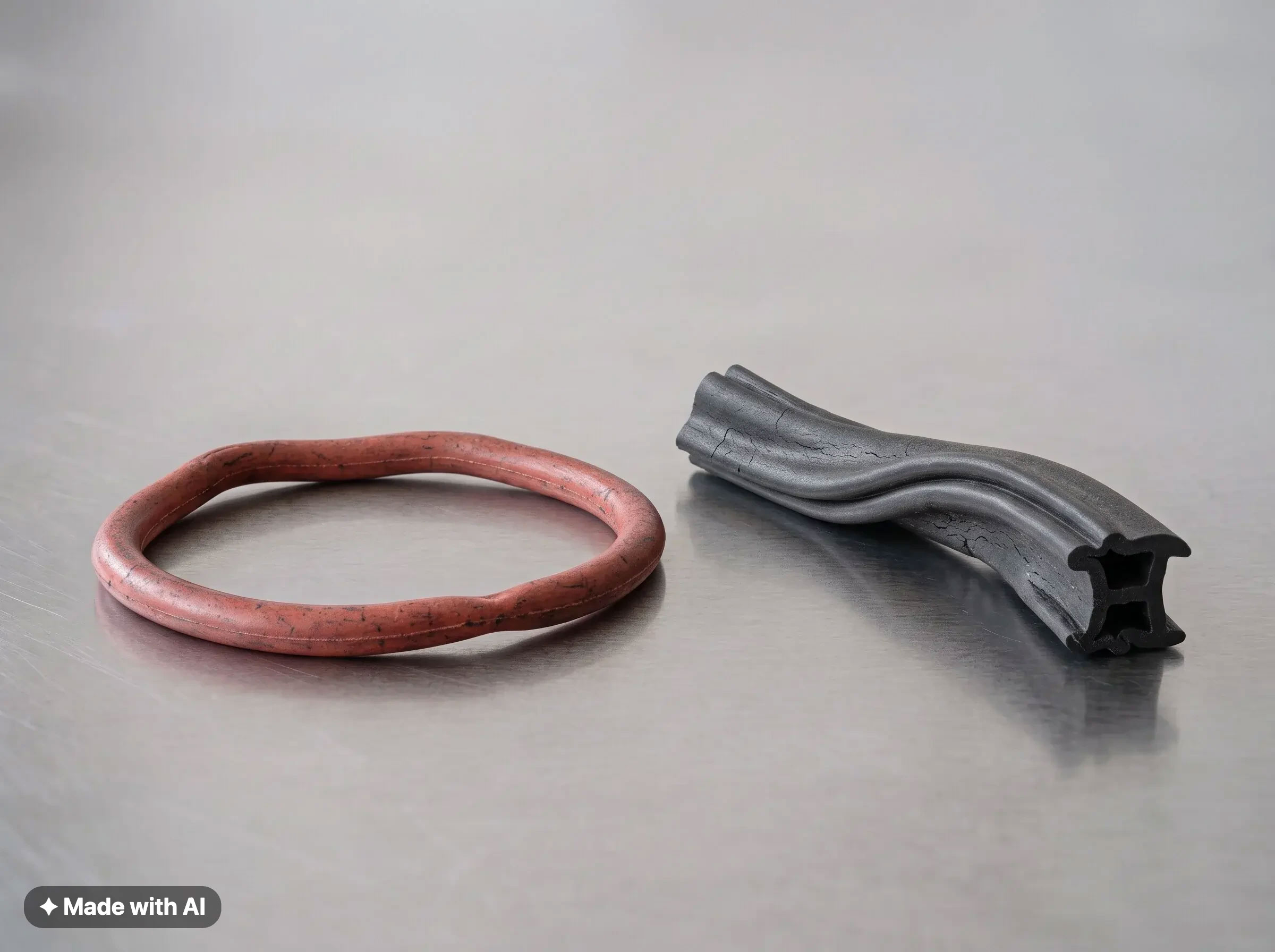
In the case of plastic deformation, part of the change in shape persists even after the load has been completely removed – the deformation is permanent. In sealing technology, plastic deformation is generally a sign of damage: a sealing element that yields permanently under pressure loses its restoring force and preload. The result is a reduction in contact force at the sealing surface, which gradually leads to leakage.
The most important parameter for assessing this behaviour is the compression setor DVR: it describes the proportion of an applied compression that remains permanently after a defined time and at a defined temperature – i.e. that is not elastically restored. A low DVR is essential for permanently compressed seals.
Factors influencing deformation behaviour
The extent to which an elastomer deforms, and the nature of that deformation, depends on several factors:
- Material type and compound– the cross-linking system, filler package and plasticiser content determine stiffness, resilience and creep tendency
- Temperature – as the temperature rises, the viscous component of the behaviour increases and the plastic components grow; high-temperature applications place particular demands on the DVR
- Duration of loading – even below the yield point, elastomers exhibit time-dependent effects: under constant compression, their restoring force diminishes over time (stress relaxation); under constant pressure, they can continue to deform (creep). Both reduce the effective sealing performance over time.
- Effect of the medium – swelling due to absorption of the medium drastically alters the deformation behaviour. A swollen elastomer behaves more softly, loses mechanical strength and exhibits altered recovery characteristics. Significant swelling is also always an indicator that the limits of the chemical resistanceof the compound for this specific medium have been reached.
Significance in seal design
In practice, this means that the boundary between elastic and plastic deformation in elastomers is not a sharp line, but a gradual transition that depends on temperature, time and the medium. A seal that still recovers fully at room temperature may undergo plastic flow under the same installation conditions at a permanently elevated temperature and lose its function.
Therefore, in addition to the choice of material, the installation compression, the groove geometry and the clearanceplay a decisive role – together, they determine the load under which a sealing element operates and whether it remains permanently within the elastic range.
Translated with DeepL.com (free version)
Contact