
Fatigue in Elastomers
Material fatigue refers to the progressive failure of a material under cyclic or sustained loading which, taken on its own – as a single static load – would not yet cause failure. The material is therefore not destroyed by a single overload, but by the repeated or continued action of a force that lies below the actual load limit. The insidious thing about this: the damage often does not announce itself visibly and progresses concealed within the interior of the material.
How fatigue arises in elastomers
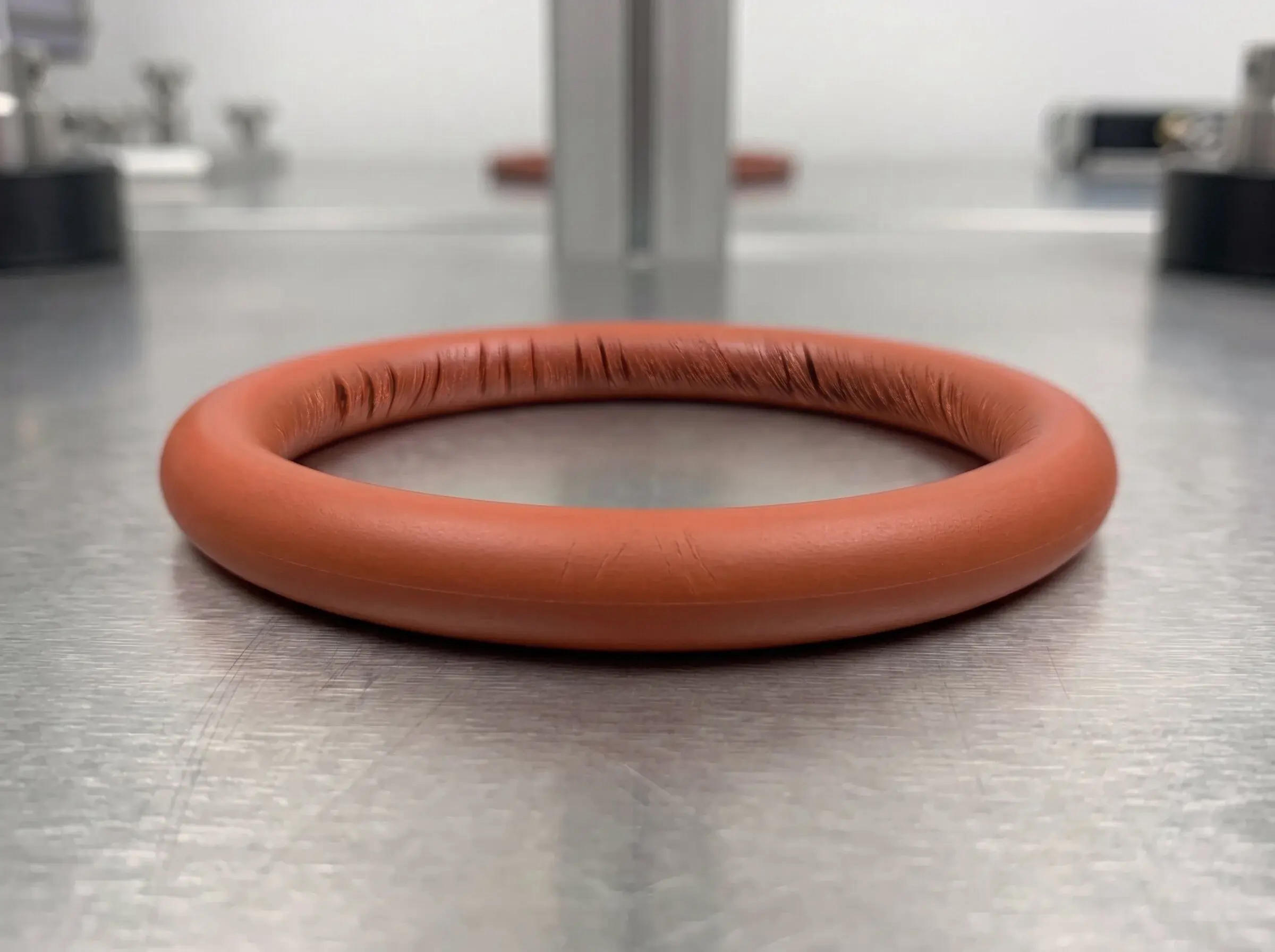
In elastomers, fatigue typically begins with the formation of microscopically small cracks – at flaws in the vulcanisate structure, at filler agglomerates, notches or surface defects. Under cyclic loading, these micro-cracks grow further with each load cycle. As soon as a crack has reached a critical length, it spreads abruptly – the material fails.
This process is referred to as fatigue cracking and is the characteristic damage pattern of dynamically stressed elastomer components. Affected above all are sealing elements exposed to reciprocating movements or pressure changes, as well as damping and mounting elements under oscillating load.
Influencing factors
How quickly an elastomer fatigues depends on several factors that interact in practice:
- Load amplitude and frequency – more load cycles per unit of time accelerate crack propagation. The dynamic fatigue test is the standard method for assessing the dynamic fatigue behaviour.
- Temperature – heat, and in particular high heat, accelerates ageing and additionally weakens the polymer network.
- Dissipation energy (heat build-up) – with every deformation, elastomers convert part of the energy introduced into heat. At high frequencies, this can lead to a massive self-heating of the component, which accelerates thermal ageing and drastically reduces the fatigue strength.
- Influence of media – oils, fuels or other media can cause swelling and alter the mechanical properties of the compound, which directly influences the fatigue resistance.
- Surface condition and installation geometry – notches, sharp edges in the seat geometry or impermissible deformation during installation are frequent starting points for fatigue cracks.
- Ozone – in elastomers with double bonds in the polymer backbone such as NBR, ozone acts synergistically together with mechanical stress.
Particularly critical: ozone cracks arise only under mechanical tensile stress – a relaxed component remains largely protected. Under dynamic loading, however, new crack flanks are constantly being broken open, offering the ozone ever new surfaces to attack. This effect is referred to as dynamic ozonisation.
Fatigue and material selection
For dynamically stressed components, fatigue resistance is a central selection criterion. Alongside the rubber type, the decisive factors here are above all the cross-linking system and the filler package: sulphur-cross-linked compounds with an active carbon black filler generally show better dynamic properties than peroxide-cross-linked grades, which in turn, however, offer a better compression set. This conflict of objectives is well known in compound development and is weighted differently depending on the application profile.
In laboratory testing, fatigue resistance is frequently determined using the De Mattia method to DIN ISO 132, in which the crack growth rate of a notched specimen is measured under cyclic flexing load. In addition, the dynamic fatigue test is used for dynamically stressed components under defined amplitudes and frequencies.
The tensile strength and the tear propagation resistance are the static characteristic values that correlate most closely with fatigue resistance – a material with high tear strength and good tear propagation resistance is generally also more resistant under dynamic load.
Contact