
Time-oscillation test
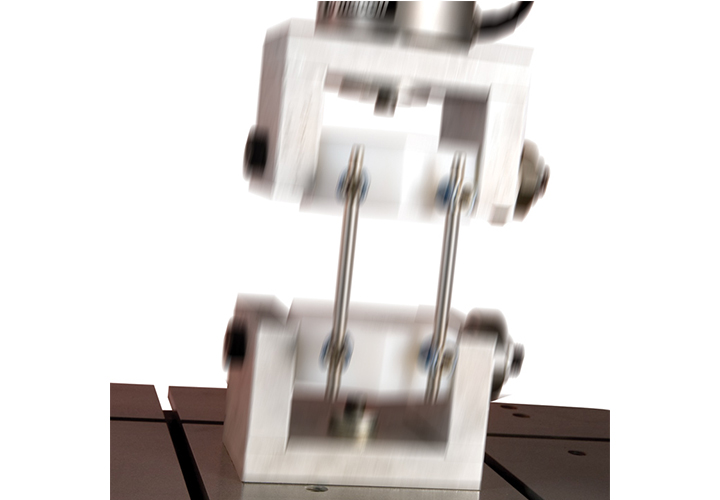
The fatigue test (also known as time-cycle fatigue test) is a testing procedure used to examine the behavior of a material under oscillating or cyclic loading. While static short-term and long-term characteristic values (e.g., tensile strength, creep behavior) only represent loading from a single continuous force, the fatigue test shows how many load cycles a plastic or elastomer can withstand before cracking or failure occurs.
Objectives of the Fatigue Test
For many components – such as clips, snap-fit connections, bearing elements, or seals in pulsating systems – the load is not constant but alternating. The fatigue test clarifies:
- How the material reacts to periodic tensile, compressive, or bending loads,
- At which stress levels fatigue occurs,
- After how many load cycles (oscillations) cracks form or failure occurs.
The result is often represented as a Wöhler curve (S-N curve: Stress vs. Number of cycles) and allows for a fatigue-resistant design of the component.
Test Procedure
In a fatigue test, a standardized specimen or a component-like test body is:
- Subjected to a defined alternating stress (e.g., symmetrical tension-compression oscillation, pure tensile oscillation),
- Cyclically stressed at a specified frequency (e.g., from a few Hz up to higher frequency ranges),
- Tested until either a fracture occurs or a predefined number of load cycles is reached.
A series of tests at different stress levels provides a comprehensive picture of the material's fatigue strength.
Significance for Plastics and Elastomers
Especially for plastics and elastomers, static characteristic values are often insufficient because:
- Time and temperature dependency (viscoelasticity) strongly influence behavior,
- Micro-cracks and fatigue damage build up gradually under cyclic loading,
- Components in practice often experience millions of load cycles (e.g., pumps, valves, vibration elements).
The fatigue test therefore provides critical data for:
- Seals and O-rings in pulsating hydraulic or pneumatic systems,
- Profiles and molded parts subjected to oscillating or alternating loads (e.g., bearings, buffers, or spring elements),
- Technical plastic components with snap-fit or bending areas that are frequently actuated.
In this way, the fatigue test helps to harmonize material selection, geometry, and safety factors so that components operate with fatigue limit durability and do not fail prematurely due to fatigue.
Contact