
Compression set testing of elastomers
The compression set test is a standardised test method for assessing the recovery behaviour of elastomers following prolonged compression. It determines the compression set – abbreviated to DVR or, in English, ‘compression set’ – one of the most meaningful parameters in sealing technology, as it directly reflects how well an elastomer can maintain its recovery force and thus its sealing performance over time and across temperature ranges. The most common test standards are DIN ISO 815 and ASTM D-395.
How the compression set test is carried out
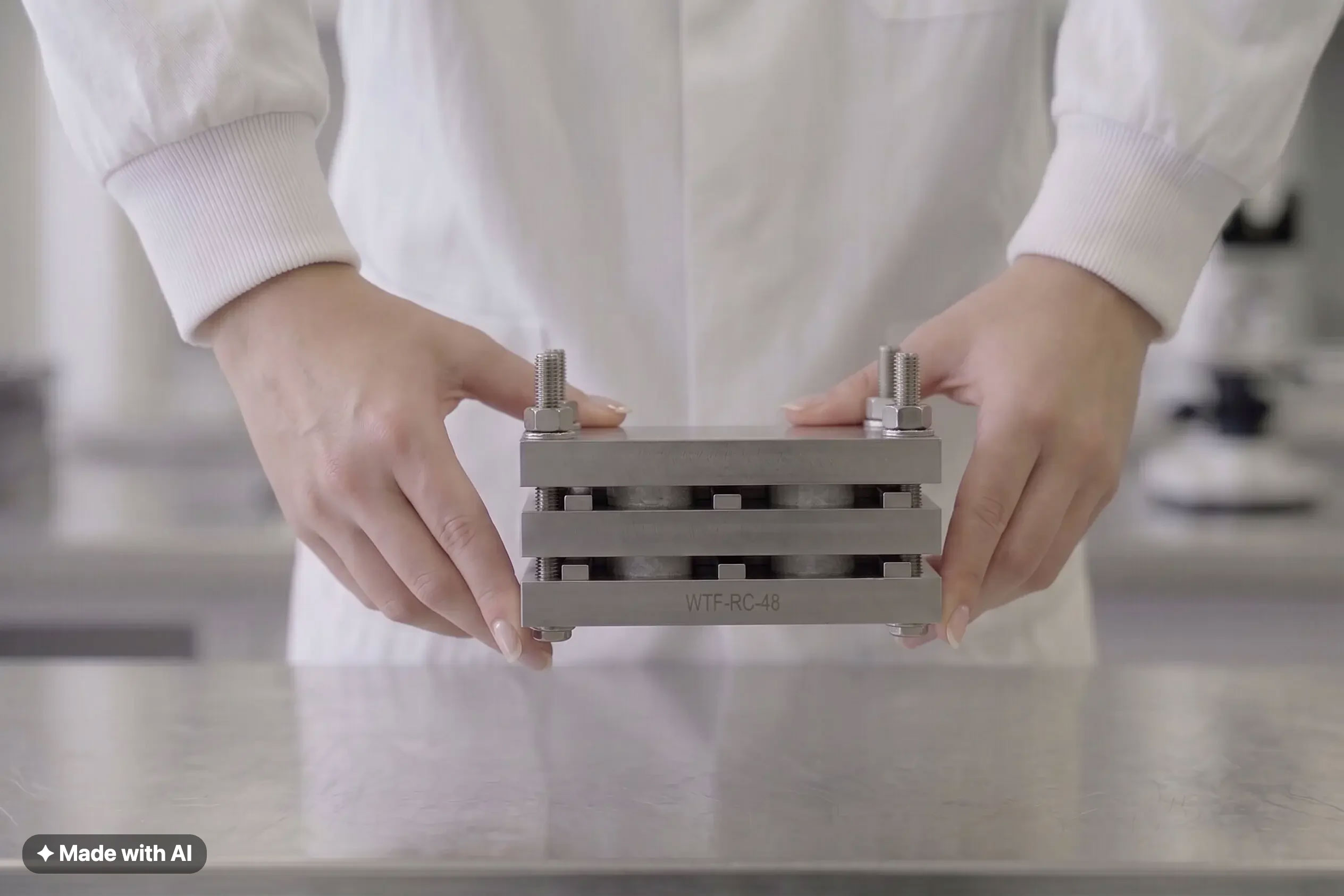
A standardised test specimen – usually a cylindrical disc – is compressed, typically by 25 per cent of its initial height, using spacers. The test is usually carried out at elevated temperatures in a heating chamber to simulate accelerated ageing under real-world conditions.
For applications where low temperatures are a critical factor, the test can also be carried out at sub-zero temperatures to assess the elastomer’s resistance to freezing. Once the test period has ended, the compression device is removed. The test specimen recovers at room temperature, and after a defined waiting period – 30 minutes by default – a measurement is taken of how much of the original deformation has remained permanently.
The result is always expressed as a percentage:
- DVR = 0 % indicates complete recovery – the test specimen has returned exactly to its original thickness
- DVR = 100 % indicates no recovery – the test specimen remains permanently in its compressed state
The lower the compression set, the better the material’s ability to recover.
Test methods in accordance with ASTM D-395
The compression set test can be carried out using various methods. The methods specified in ASTM D-395 are widely used:
• Method A – constant force: The test specimen is subjected to a defined, constant compressive force. The resulting deformation depends on the material and varies.
• Method B – constant compression: The test specimen is compressed to a specified depth, typically by 25 per cent of its original thickness. This method is more commonly used in practice because it better reflects the real-world installation conditions of seals – such as the compression of an O-ring in its groove.
A DVR of 50 per cent in Method B specifically means that, of the 25 per cent compression applied, half – i.e. 12.5 per cent of the original thickness – remains permanently deformed. The seal has consequently lost some of its recovery force.
In addition to ASTM D-395, DIN ISO 815 is frequently used in Europe; this standard differs in some respects in terms of methodology and test specimen geometry – results from different standards are therefore only directly comparable to a limited extent.
When a high DVR becomes critical – and when it does not
A low DVR is desirable for most sealing applications, but the assessment always depends on the specific application.
In the case of static sealing points – such as flat seals between flange faces or O-rings in stationary joints – a seal can still fulfil its function even with a DVR of up to 90 per cent, provided the system pressure remains constant and no external forces act on the sealing element. Although the restoring force is then largely exhausted, the seal still contacts the mating surface.
A high DVR becomes critical when:
- system pressure fluctuations occur – in which case the decreasing preload can no longer be compensated for and leakage paths develop
- contact with the medium causes the elastomer to shrink (volume loss due to the extraction of plasticisers or other compound components) – the already reduced preload decreases further until the sealing effect is lost
- dynamic loading is present – during reciprocating or rotational movements, even a moderate DVR is sufficient to compromise the sealing function prematurely
Conversely, swelling caused by media absorption can partially compensate for a high DVR: a swollen elastomer increases in volume and thereby raises the contact pressure at the sealing point – even if the material’s resilience has already diminished significantly. However, this effect is not a reliable design parameter, but rather a random result of the interaction with the media.
DVR as a selection criterion in material selection
In practice, alongside media resistance and operating temperature range, DVR is one of the most important selection criteria for sealing materials. Peroxide-cured compounds generally exhibit significantly better DVR values than sulphur-cured grades – particularly at elevated temperatures. FKM and EPDM with peroxide curing are among the elastomers with the best high-temperature DVR; NBR exhibits good values at moderate temperatures, but its performance deteriorates more rapidly under sustained thermal stress.
Contact