
Extruder
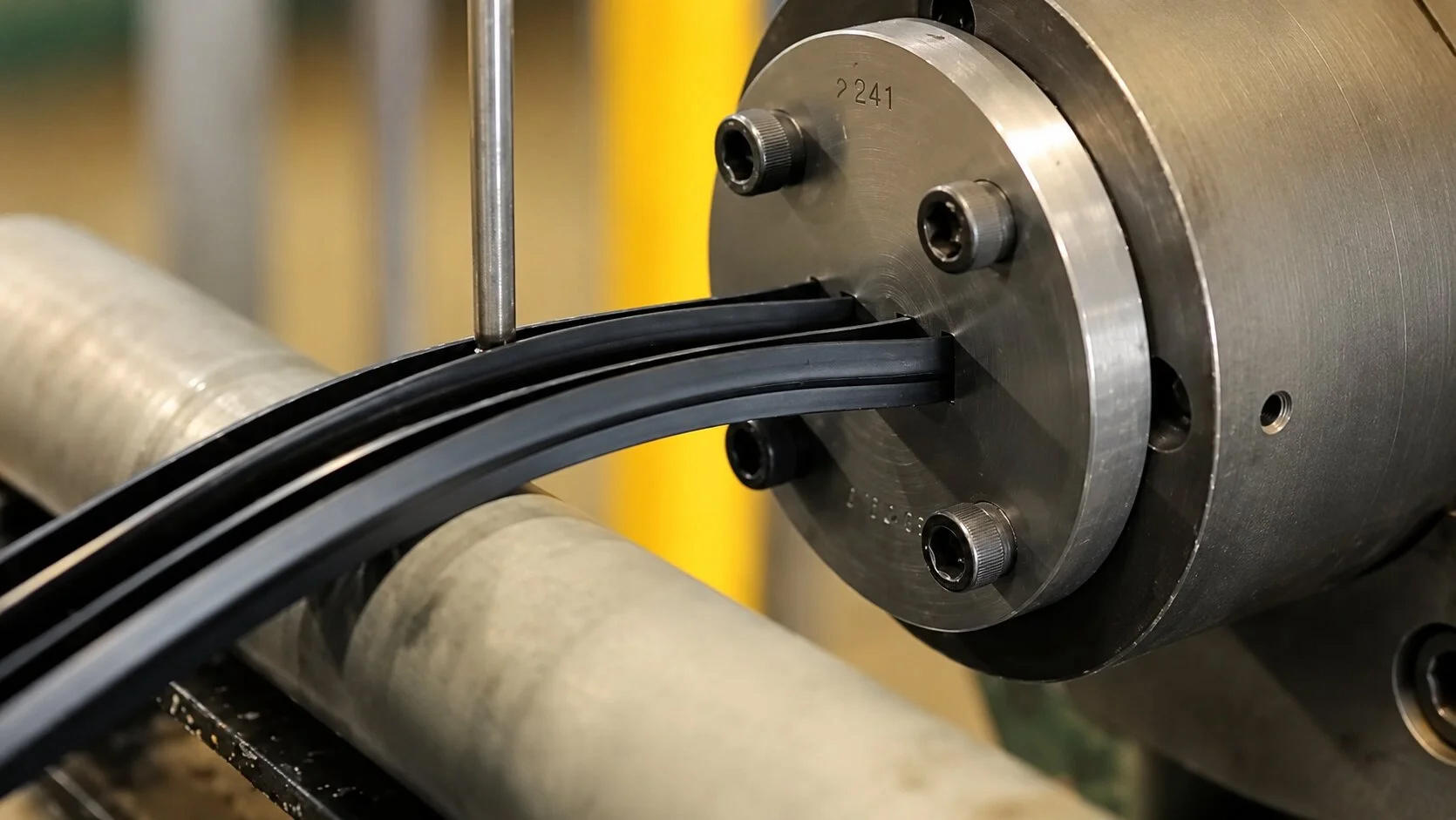
The extruder is the central machine in the continuous processing of rubber mixtures for the manufacture of profiles and hoses. In contrast to discontinuous processes such as injection moulding or the platen press, the extruder operates in continuous mode: material is fed in continuously, processed and discharged as an endless semi-finished product. This makes it the standard unit for the manufacture of sealing profiles, cable sheaths, hose semi-finished products and profile strands in any length.
Design and operating principle
A rubber extruder consists essentially of a heatable metal cylinder and a conveying screw rotating axially within it. The unvulcanised rubber mixture – cold and viscoplastic – is fed into the cylinder at the intake. From there, the screw takes on three essential tasks simultaneously:
It conveys the mixture towards the tool – also known as the nozzle, mouthpiece or die – homogenises it through the shear action introduced, and heats it through the combination of friction heat and external heating of the cylinder. At the outlet, the mixture is warm, plastic and fluid enough to be forced through the shaping tool – the so-called extrusion die.
In modern manufacturing, cold-feed extruders are predominantly used. These have longer screws and often special mixing elements (pins) in order to bring the unvulcanised mixture directly from room-temperature level up to the required processing temperature – the separate pre-warming step on a hot roller that used to be customary is thereby eliminated. In order to remove air inclusions or moisture from the mixture, many lines are additionally equipped with a vacuum degassing zone, which prevents pore formation in the finished profile and ensures a homogeneous surface.
The extrusion die gives the extruded strand its cross-sectional geometry. The shape and dimensions of the tool are matched to the desired profile or hose cross-section, whereby the recovery effect (die swell) of the rubber as it leaves the tool must be taken into account in the design in order to ensure the required dimensional accuracy.
Temperature and pressure control
Temperature and pressure are the critical process parameters in extrusion. The melt temperature must be high enough to ensure sufficient flowability and a homogeneous extrusion – but must not rise so far that vulcanisation already sets in within the cylinder.
This so-called scorching, that is, the premature onset of vulcanisation of the mixture, is one of the most common faults in the extrusion process and leads to inhomogeneities in the strand or complete tearing-off of the material. The processing safety of a compound against scorching is determined in advance in the rheometer.
The melt pressure builds up through the resistance of the shaping tool and ensures a uniform, bubble-free discharge of material. Pressure fluctuations – for example due to uneven material feed or fluctuating mixture viscosity – are directly reflected in dimensional fluctuations of the profile strand.
Vulcanisation following extrusion
The extruded strand leaves the extrusion die in the unvulcanised state – it does have its final cross-sectional shape, but as yet no elastic properties. Vulcanisation takes place in a downstream vulcanisation line connected directly to the extruder. Common processes are the salt-bath vulcanisation channel (LCM), the hot-air channel or the microwave channel (UHF), which vulcanises the mixture from the inside out by means of dielectric heating – although this process is limited to polar mixtures such as NBR, EPDM or CR, since non-polar materials absorb hardly any energy in the microwave field.
The coordination of extrusion speed and vulcanisation time is decisive for the profile quality: if the strand runs through the vulcanisation line too quickly, it remains under-vulcanised. Too slow means over-vulcanisation with correspondingly embrittled properties.
Applications of extruded elastomer components
The extrusion process is the preferred manufacturing method for all elastomer components with a constant cross-section and any length:
- Sealing profiles for windows, doors, façades and vehicles
- Sponge rubber profiles for compressible seals
- Hoses for technical applications in industry and vehicle construction
- Cable sheathing and cable jackets
- Profile strands for general mechanical engineering
Contact