
Assembly
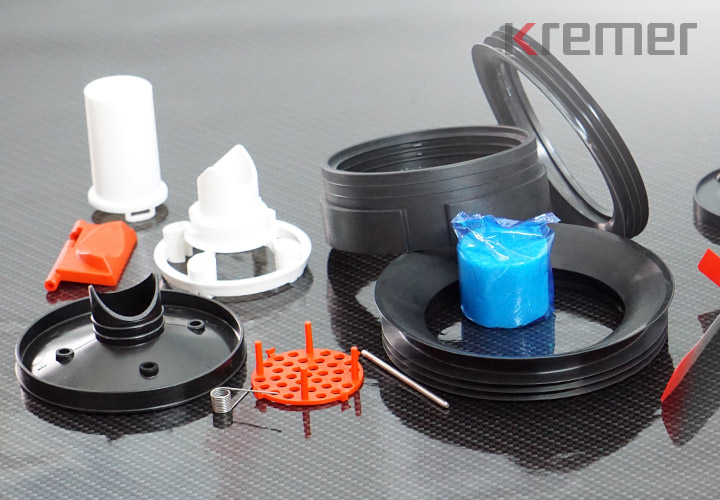
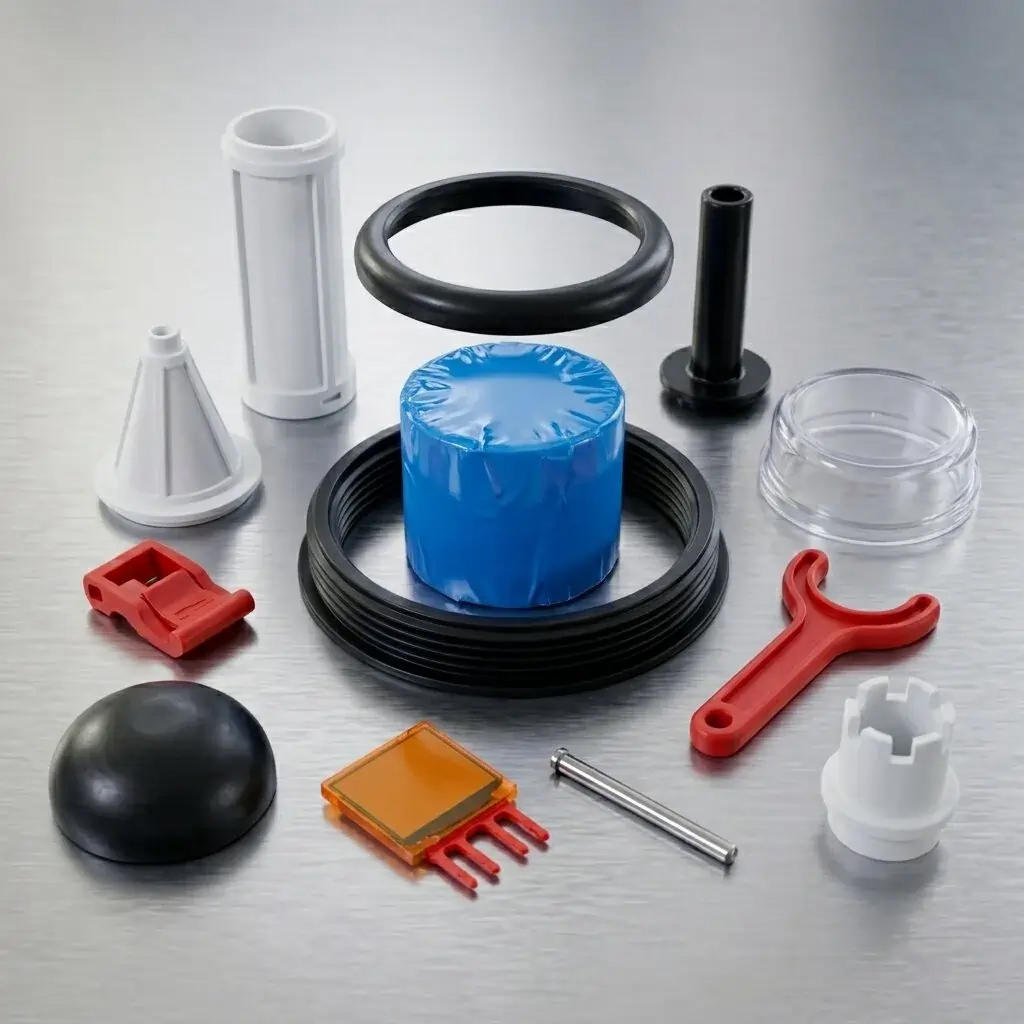
An assembly is a pre-assembled functional unit made up of several individual parts that together perform a defined task. In parts lists and drawings it is often managed like a part in its own right – including an article number, inspection characteristics and a clear assembly sequence. Depending on the complexity, the terms sub-assembly, assembled component or, in an international context, assembly are also used.
An illustrative example from sealing technology is a plastic housing consisting of an upper and a lower part, which only becomes reliably tight once a seal is added – for example as an inserted gasket or profile seal, or as an O-ring. In many applications, the sealing function is located at precisely the point where assemblies become more expensive in practice: additional parts, additional handling operations, additional sources of error.
Why assemblies are so attractive in series production
In industrial manufacturing, assemblies are rarely about simply "screwing things together". They are about reducing effort – along the entire chain: fewer items in the parts list, fewer incoming goods, less order picking, fewer assembly steps. This is precisely why, with assemblies, the approach frequently chosen is that the partner with the largest share of value creation not only supplies individual components, but also procures, assembles and packages bought-in parts – until the component arrives on the line as a ready-to-install unit.
Assembly and seal: loosely inserted or integrated
Particularly in the case of housings, lids, covers, valve seats or plug connections, the seal determines the functional reliability of the entire assembly. In practice, two approaches are common:
- Seal as a separate part (e.g. O-ring, gasket/profile seal): easily replaceable, but with additional handling.
- Sealing function as part of the assembly (e.g. pre-assembled or process-integrated): reduces assembly effort and stabilises the process – especially in high-volume series. (Which technology is used depends on the project.)
Typical sealing components frequently combined within assemblies include, in addition to O-rings, tool-bound elastomer moulded parts, sponge rubber elements, gaskets, hose rings or profiles.
One technical risk that must be addressed early in assemblies with a sealing function is the tolerance chain: the individual tolerances of all components – housing, lid, fastening elements, seal – add up. In the worst case, the resulting compression of the seal may either be too low and cause leakage, or so high that the housing distorts or breaks. A tolerance-chain analysis is therefore not regarded as an optional development step, but is a prerequisite for ensuring that the sealing gap remains within specification in every manufacturing condition.
Development: test early, before tooling costs begin
In assembly projects, testing early pays off: geometry, fit, assembly sequence, sealing gap/gap dimension and serviceability. Because whoever supplies an assembly supplies a function, not simply individual parts. This means that responsibility for testing must be clearly defined. An O-ring that is dimensionally accurate and perfectly sound in isolation may sit incorrectly in the assembled unit and make it leak.
Functional and leak-tightness tests at the end of the assembly chain – such as a pressure-decay test or helium leak test – are therefore an integral part of assembly manufacturing and must be defined in the specification. In practice, rapid sampling is often used for this purpose – for example via rapid prototyping, before series tooling for injection moulding or extrusion is commissioned.
During automated assembly, transverse forces also arise that can shear off or twist a seal – especially in tight installation situations. Chamfers on the housing, PTFE coatings or approved lubricants reduce these assembly forces and ensure the correct final position of the seal. Whatever goes unnoticed in individual-part inspection will show up at the latest in the end-of-line test.
Contact