Blog
Blog article
When standard elastomers fail: FKM for high-temperature applications
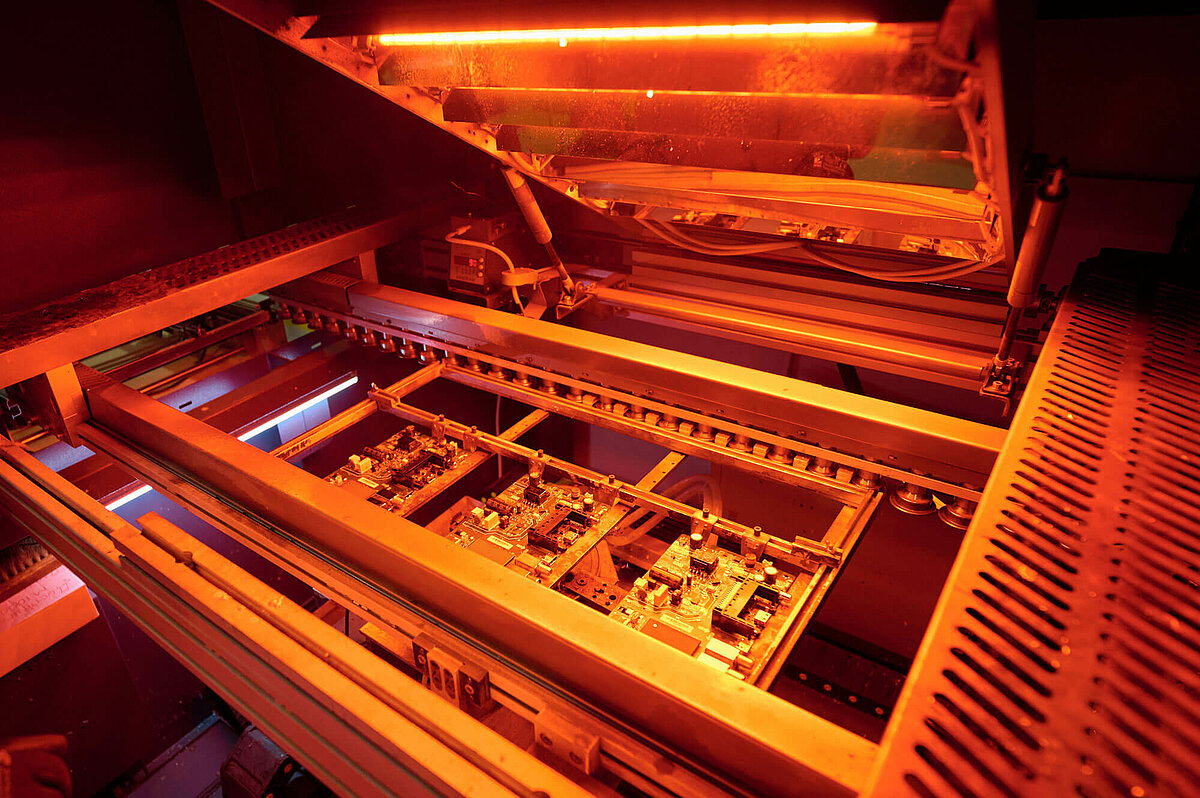
Extreme temperatures are among the greatest challenges in design and material selection. Particularly in industrial processes where thermal stresses are deliberately applied, all components used must function reliably – even under extreme conditions. A typical example of this is reflow soldering in electronics manufacturing. This illustrates just how crucial the right choice of materials is for process reliability.
Reflow soldering is an established process for joining electronic components to printed circuit boards. Unlike traditional soldering with a soldering iron, the complete, pre-assembled board with solder paste applied is passed through an oven. There, the solder is selectively melted, creating electrical and mechanical connections simultaneously. This process is particularly indispensable for very small and densely packed components, as it is virtually impossible to work with sufficient precision manually.
The challenge lies in the thermal stress: temperatures of up to 250 °C are reached during the process. Although these temperatures are only applied for a short time, they place enormous demands on all materials already present on the assembly – including seals. This is precisely where fluorocarbon rubber (FKM) comes into play.
FKM is a high-performance elastomer characterised by exceptional temperature resistance. Whilst many conventional elastomers rapidly lose their properties at temperatures above 150 °C, FKM remains functional even at significantly higher temperatures. Short-term temperature spikes, such as those occurring during reflow soldering, can be easily withstood by appropriately formulated FKM compounds.
In practice, this means that seals can be mounted on the PCB even before the soldering process. An additional assembly step after soldering is not required. This not only reduces the effort involved in production but also minimises potential sources of error. The seal is positioned exactly where it is needed – without the need for subsequent adjustment or the risk of damage.
However, the requirements go beyond mere temperature resistance. During the reflow process, thermal stresses also act on the materials. Different coefficients of thermal expansion in the PCB, components and seal can lead to mechanical stresses. A suitable material must therefore not only be heat-resistant, but also remain elastic and resilient.
This is where the strength of high-quality FKM materials comes into its own: they combine thermal stability with excellent chemical resistance and mechanical strength. Even after repeated temperature cycles, they retain their sealing function. This is crucial for applications where long-term reliability is essential.
Another important aspect is process reliability. In automated manufacturing environments, all components must function consistently. Even the slightest deviations can lead to scrap or failures. The use of suitable FKM seals can significantly reduce such risks. The materials are designed to maintain defined properties consistently across a wide temperature range.
This is precisely where we come in: the selection of the right material is always application-specific. After all, not all FKM is the same: different compounds offer different properties in terms of temperature resistance, chemical resistance and mechanical performance. The key is to ensure the material is optimally suited to the specific application. Furthermore, in the example given, a non-outgassing silicone would also be a viable option.
It is clear that, particularly under extreme operating conditions, it is advisable to seek expert material advice at an early stage. At KREMER, we support designers and technical buyers in finding the right solution – from material selection to the finished seal. The aim is to design components so that they can withstand the real-world stresses of the process whilst also being manufactured cost-effectively.
Do you have an application with extreme conditions? Get in touch – we’d be happy to advise you!

Lars Jung is a Technician for Plastics and Rubber Technology at KREMER Technology GmbH. Since 2019, he has been supporting client projects from the initial concept through to final implementation. He is recognised for his meticulous approach and his dedication to developing creative technical solutions for complex requirements.

KREMER - the specialist for customised elastomer and plastic products
KREMER was founded in 1965 and has been part of the REIFF Group since 1995. KREMER focuses on the product groups of seals, O-rings and moulded parts made of rubber, plastic and thermoplastic elastomers. Two-component products, rubber-metal compounds, sponge rubber profiles, rubber profiles and hose rings complete the extensive product range.
Press contact:
Kremer Technology GmbH
Tim Oettmeier
Kinzigstr.
9
63607 Wächtersbach
Phone: 06053 – 61610
E-mail:
tim.oettmeier@kremer-tec.de