Blog
Blog article
A secure fit during use: silicone head and neck straps for respiratory masks
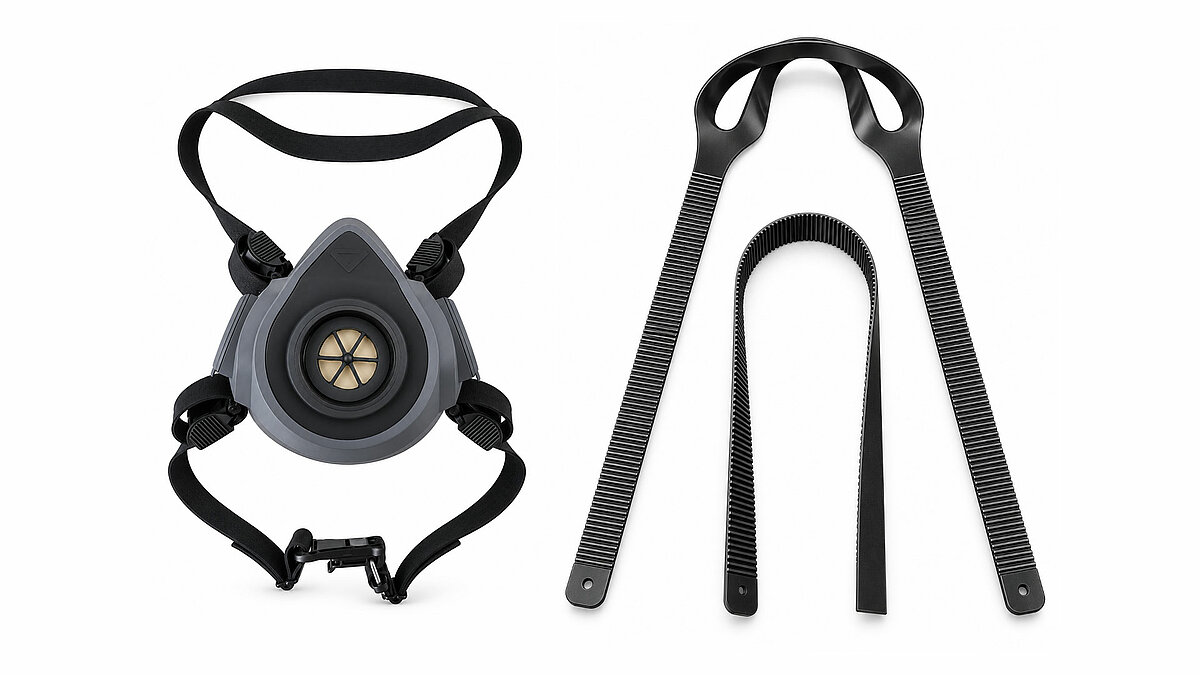
When it comes to respiratory protection masks, it is not just the body of the mask that determines safety and comfort. Even seemingly simple components such as head and neck straps play a vital role: they hold the mask securely in place and ensure that it can be adjusted to fit different head shapes. Particularly in applications within the fire service or in specialised industrial sectors, these components must therefore withstand high mechanical stresses.
KREMER manufactures special head and neck straps as moulded elastomer parts made from silicone for a manufacturer of respiratory protection masks. The development process focused on three key requirements: high elasticity and tear resistance, a material suitable for skin contact, and cost-effective production of the various strap variants.
Head and neck straps fulfil an important retaining function
At first glance, the straps’ function seems simple: the respiratory protection mask must be secured to the wearer’s head. From a technical perspective, however, this gives rise to various requirements.
The straps must be sufficiently stretchable so that the mask can be put on comfortably and adapted to different head shapes. At the same time, they must not stretch uncontrollably or become damaged under the constant tensile load. High tear resistance is also particularly important. After all, the straps are subjected to mechanical stress every time the mask is put on or taken off.
KREMER manufactures several silicone moulded parts specifically tailored to the design of the respiratory protection mask. One head strap and two neck straps are required per mask. The mask is held in place at various points by the individual straps, enabling it to be securely positioned on the head.
In the areas designed as ribbed straps, the geometry also fulfils a functional role. The textured surface, in conjunction with the corresponding mounting and adjustment elements, enables the straps to be positioned precisely. This transforms what appears to be a simple rubber strap into a functionally precise component, carefully engineered to fit the design.
Silicone combines elasticity with high tear resistance
A silicone with high tear resistance and a high elongation at break is used for the straps. This combination is particularly important for this application.
A high elongation at break means that the elastomer can be stretched significantly before material failure occurs. This facilitates both putting on the mask and adapting it to different wearers. At the same time, the material must be able to withstand the tensile forces encountered during use on a long-term basis.
Direct contact with the user also plays an important role in the choice of material. During use, the straps are sometimes in direct contact with the skin. When of a suitable quality, silicone is physiologically harmless and is therefore of interest for applications where elastomer components come into contact with human skin.
Added to this are typical properties of silicone, such as its permanent elasticity and good resistance to ageing, ozone and weathering. Particularly in the case of long-lasting technical products, these properties can be a key factor in the choice of material.
Moulded parts instead of simple rubber straps
This application also demonstrates why such components should not simply be referred to as ‘rubber straps’. The head and neck straps are geometrically defined moulded elastomer parts, the dimensions and surface structures of which are tailored to the overall system of the respiratory protection mask.
For designers, this means that, in addition to length, width and material thickness, transitions, radii and textured areas must also be taken into account. At the same time, the component geometry influences the subsequent mould design and thus directly affects manufacturing costs.
It is therefore worthwhile to consider the design, material and manufacturing process together at an early stage of the project. In the case of silicone moulded parts, a production-oriented design can play a decisive role in realising a technically reliable and, at the same time, cost-effective series production solution.
Combined mould produces complete sets in the correct proportions
A particular focus of the project was on cost-effective mould design. A respiratory protection mask requires one head strap and two neck straps. The neck straps are therefore generally required in double the quantity.
The combination mould, specially tailored to this requirement, directly reflects this ratio: three head straps and six neck straps are produced per production cycle. The mould thus produces the parts in a 1:2 ratio, which corresponds exactly to the actual requirement per mask.
This concept offers several advantages for technical procurement. The required individual parts are produced in sync, the manufacturing process becomes more efficient, and the effort involved in volume planning and stock management can be reduced. At the same time, mould capacity can be specifically tailored to the actual requirements of the subsequent assembly.
This example shows that economic optimisation for elastomer moulded parts does not necessarily have to focus on the component itself. Often, a well-thought-out mould concept is a key lever for improvement.
Considering the component, material and mould together
Head and neck straps for respiratory masks are a good example of how many requirements come together even in seemingly simple elastomer components. High elasticity, tear resistance, skin contact and a precisely defined geometry must be taken into account, as must cost-effective mass production.
KREMER therefore supports such projects not only in selecting the appropriate elastomer. Component geometry, the mould design and the quantities required at a later stage are also incorporated into the technical assessment.

André Hensel is a Technical Project Manager at KREMER Technology GmbH. With over 20 years of experience at a leading automotive supplier, he possesses extensive expertise in the development and implementation of complex rubber moulded parts. He manages projects with a commitment to the highest standards of precision and technical feasibility.

KREMER - the specialist for customised elastomer and plastic products
KREMER was founded in 1965 and has been part of the REIFF Group since 1995. KREMER focuses on the product groups of seals, O-rings and moulded parts made of rubber, plastic and thermoplastic elastomers. Two-component products, rubber-metal compounds, sponge rubber profiles, rubber profiles and hose rings complete the extensive product range.
Press contact:
Kremer Technology GmbH
Tim Oettmeier
Kinzigstr.
9
63607 Wächtersbach
Phone: 06053 – 61610
E-mail:
tim.oettmeier@kremer-tec.de